
Key Takeaways
- Best overall: Editorial.Link — published pricing, site approval before outreach, no retainer minimum
- Typical spend: $3,000–$10,000 per month for most SaaS companies; $220–$2,000 per link depending on method
- Realistic timeline: 6–12 weeks for early movement, 3–6 months for compounding impact
- The pages that matter: Feature, integration, comparison, and alternatives pages — not just blog posts
- Biggest risk: Sub-$50 links from PBNs and link farms, which cost more to clean up than to avoid
- New in 2026: Listicle placements now influence whether ChatGPT and AI Overviews recommend your product
Buying Backlinks for a SaaS Company Is Easy to Get Wrong
The market is crowded with vendors selling DR50 placements for $79 on sites that few people read. It’s also full of premium agencies charging $15,000 a month with a six-month lock-in and no sample placements shared up front. Somewhere between those two extremes sits the provider that fits your budget and your stage.
The problem is that almost every “best SaaS link building services” roundup is written by an agency that ranks itself #1 and doesn’t mention it. Most also skip the one thing you came for: what each provider actually charges.
This guide fixes both. We scored 15 providers against 10 criteria — pricing, link quality, outreach process, white-hat practices, reporting, industries served, turnaround time, SaaS specialization, transparency, and best-fit use case. Where pricing is published, it’s listed. Where it isn’t, we say so rather than guessing.
You’ll also get cost benchmarks, contract terms to watch, red flags, and the questions that separate a real partner from a reseller.
Quick Answer: Top 5 SaaS Link Building Services
The best SaaS link building services in 2026 are Editorial.Link for transparent pricing and site pre-approval, uSERP for high-authority digital PR placements, dofollow.com for SaaS-only credit-based campaigns, Linkbuilder.io for published retainer tiers, and Siege Media for content-led link earning.
- Editorial.Link — Best overall for transparency and published pricing
- uSERP — Best for DR70+ editorial and digital PR placements
- dofollow.com — Best SaaS-only specialist with flexible budgeting
- Linkbuilder.io — Best for mid-market SaaS with defined monthly targets
- Siege Media — Best for content-led link acquisition
Comparison Table: 15 SaaS Link Building Services
Verified July 2026 from published rate pages and third-party review data. Confirm directly before purchasing — rates change.
| # | Provider | Starting Price | Model | Turnaround | Best For |
| 1 | Editorial.Link | $375/link · $1,750 for 5 | Per-link or package | 30–45 days | Approving sites before outreach |
| 2 | uSERP | Reported $3,000–$10,000+/mo | Retainer (3–6 mo min) | 45–60 days | Funded SaaS chasing DR70+ |
| 3 | dofollow.com | Reported $3,000–$4,000/mo min | Credit-based | 30–45 days | SaaS-only budget control |
| 4 | Linkbuilder.io | $2,999/mo for 8 links | Retainer or per-link | 30–45 days | Fixed monthly link targets |
| 5 | Siege Media | Custom (reported $7,500+/mo) | Retainer | 60–90 days | Content-led growth programs |
| 6 | Skale | Quote only | Retainer | Campaign-based | SEO and links together |
| 7 | SAASY LINKS | Quote only | Retainer | 30–45 days | SaaS-only specialist support |
| 8 | Page One Power | Custom (reported low four figures+) | Retainer or project | 45–60 days | Long-term authority programs |
| 9 | Stellar SEO | Quote only | Retainer or per-link | 30–60 days | Regulated and niche verticals |
| 10 | Outreach Monks | Packages by DR tier | Monthly packages | 20–30 days | Predictable monthly delivery |
| 11 | Loganix | Guest posts from ~$200/link | Self-serve or subscription | 20–30 days | Agency white-label supply |
| 12 | RankUp4U | Quote only | Retainer | 30–45 days | Early-stage bundled SEO |
| 13 | The HOTH | Guest posts from ~$150 · HOTH X from ~$1,000/mo | Ala carte or managed | 30 days | Low-cost entry testing |
| 14 | FATJOE | From ~$83/link (DR10+) | Per-order marketplace | 5–10 days | Speed and agency resale |
| 15 | Fractl | Quote only | Project or retainer | 60–120 days | Tier 1 media coverage |
What Are SaaS Link Building Services?
SaaS link building services are agencies or platforms that earn backlinks to a software company’s website from other credible, relevant sites. They handle publisher research, outreach, content creation, and placement, with the goal of improving rankings on the pages that drive trials and demos.
The work breaks into five buckets:
- Guest posts — original articles published on a third-party site with a link back to you
- Niche edits (link insertions) — your link added into an existing, already-indexed article
- Digital PR — original research or data studies pitched to journalists
- Listicle placements — inclusion in “best tools” and “alternatives to X” roundups
- Link reclamation — chasing down brand mentions that never got linked
Most providers bundle several of these. A few, like Fractl, do only one.
How SaaS Link Building Differs From Regular Link Building
Three things change when the client is a software company.
The target pages are different. A local plumber wants links to a homepage. An e-commerce store wants category pages. A SaaS company needs authority on feature pages, integration pages, comparison pages, and “alternatives” pages — the URLs closest to a signup. Most agencies default to blog posts because blog posts are easier to pitch. That single habit is why so many campaigns produce authority without pipeline. Pairing link acquisition with on-page SEO on those target URLs is what turns authority into signups.
The competition is different. You’re not only fighting other SaaS brands. You’re fighting G2, Capterra, TechCrunch, and a wall of affiliate review sites with domain ratings north of 80. Generic directory links won’t close that gap.
Relevance beats raw authority. A DR40 link from a marketing operations blog your buyers actually read does more for a marketing automation tool than a DR75 link from a general business site. Any provider selling you on domain rating alone is selling the wrong metric.
Is Link Building Still Worth It for SaaS in 2026?
Short answer: yes, but the bar is higher than it was.
Backlinko’s analysis of 11.8 million search results found the #1 ranking page has 3.8x more backlinks than pages in positions two through ten. That correlation hasn’t gone away. A separate Backlinko study of 912 million articles found 94% of online content never earns a single external link — which tells you most content was never built to earn one.
What’s changed is where links pay off. Backlinks now feed AI answer engines as well as traditional rankings, a discipline the industry has started calling generative engine optimization. When ChatGPT, Perplexity, or Google’s AI Overviews recommend software, they pull from listicles, comparison articles, and editorial coverage. A product mentioned across ten trusted roundups gets cited more often than one mentioned in none.
The honest caveat: link building is not the first thing an early-stage SaaS should buy. If you have five pages of content and no product-market fit, links have nothing to amplify.
How We Evaluated These Services
Every provider was scored against the same ten criteria. Weights reflect what determines whether a campaign works.
| Criterion | Weight | What we looked for |
| Link Quality | 20% | Real organic traffic on the publisher, editorial standards, topical relevance over raw DR |
| White Hat Practices | 15% | No PBNs, link farms, recycled placements, or bulk networks |
| Outreach Process | 15% | Manual vs. templated; who writes the content; pre-placement approval |
| Pricing | 15% | Published or quote-only; per-link vs. retainer; minimum commitment |
| Reporting | 10% | Live link verification, anchor text distribution, target-URL rank movement |
| SaaS Specialization | 10% | Track record with software clients; ability to link to product pages |
| Turnaround Time | 5% | Onboarding to first live link; monthly velocity |
| Industries Served | 5% | Vertical depth vs. breadth |
| Transparency | 5% | Sample placements shared pre-purchase; replacement guarantee |
| Best For | — | Qualitative fit, not scored |
Sources. Pricing came from each provider’s published rate pages where they exist, cross-checked against third-party reviews and industry pricing studies read in July 2026. Client rosters were verified against published case studies. Review sentiment was drawn from Clutch, G2, and Trustpilot.
Limitations, stated plainly. We can only score what a provider publishes or what independent reviews confirm. Agencies that publish pricing, share sample placements, and allow site approval before outreach score higher on transparency — not because their links are automatically better, but because you can verify the claim before paying. Several capable agencies rank lower here purely because their process stays a black box until you’re on a sales call. We have not run paid campaigns with all fifteen, and we say so rather than implying hands-on testing we didn’t do.
Treat this as a shortlist, not a verdict. Then run your own checks using the questions further down. Our own SEO process uses the same framework when we audit a client’s existing link vendor.
The 15 Best SaaS Link Building Services
1. Editorial.Link — Best Overall for Transparency
Company Overview: Editorial. Link launched in 2020 out of Admix Global and operates from St. Petersburg, Florida with a distributed team. It’s a pure-play editorial link building specialist — no content retainers, no technical SEO bundles. It took the top spot on Clutch’s link building list for Spring 2026.
Best For: SaaS teams that want to see and approve every target site before outreach begins.
Core Services: Editorial link building, guest posts, AI listicle placements, competitor backlink gap analysis.
Industries Served: SaaS, B2B tech, fintech, marketing, general business.
Outreach Quality: Targets real business sites and corporate blogs that don’t sell links. Reported average placement sits around DR 67. You review each target domain with its metrics before outreach begins — uncommon at this tier.
Reporting: Live URLs, anchor text, target page mapping. Published package structure leaves little ambiguity about deliverables.
Pricing: $375 for one backlink, $1,750 for five, $6,000 for twenty. Premium placements start around $550 per link. No minimum retainer.
| ✅ Pros | ❌ Cons |
| Clearest published pricing on this list | Not a full-service SEO partner |
| Site pre-approval before outreach | Turnaround slower than marketplaces |
| No retainer minimum — good for testing | Less SaaS-exclusive than dedicated shops |
| Strong independent review sentiment | Premium per-link cost vs. bulk providers |
Why Choose Them: If an agency has ever delivered links on sites you’d never have approved, the pre-approval workflow solves that exact problem. No minimum means you can buy five links, evaluate, and walk away.
2. uSERP — Best for High-Authority Placements
Company Overview: Founded in 2019 and co-founded by Jeremy Moser and Brad Smith, uSERP is a 40-plus-person digital PR and link building agency serving high-growth technology companies. Its published roster includes monday.com, Robinhood, SoFi, BigCommerce, Freshworks, and ActiveCampaign.
Best For: Funded SaaS companies targeting DR60–90 editorial placements in publications their buyers read.
Core Services: Digital PR, editorial placements, guest content, AI visibility campaigns, SEO content production (priced separately).
Industries Served: SaaS, fintech, B2B tech, high-growth startups.
Outreach Quality: Built around journalist relationships rather than blogger networks. Placements skew toward recognizable publications, producing brand exposure alongside ranking value.
Reporting: Weekly updates, dedicated account access, regular strategy sessions. Clutch reviews confirm senior strategist involvement rather than junior handoff.
Pricing: Reported figures vary by source. Some third-party reviews cite entry retainers around $3,000–$5,000 per month; a June 2026 review reported tiers at $10,000 (Startup), $15,000 (Scale), and $25,000+ (Authority) with a six-month minimum. Confirm directly before budgeting.
| ✅ Pros | ❌ Cons |
| Highest average placement authority here | Conflicting public pricing reports |
| Named SaaS clients you can verify | Minimum commitment of 3–6 months |
| Senior team involvement confirmed in reviews | Prices out seed-stage companies |
| Publishes original research on link economics | Slower than per-link providers |
Why Choose Them: When a single placement in a major tech publication generates real referral traffic and credibility, the retainer math works. When you need ten cheap links to a blog post, it doesn’t.
3. dofollow.com — Best SaaS-Only Specialist
Company Overview: Co-founded in 2018 by Eric Carrell and Sebastian Schäffer, dofollow.com is a SaaS-focused link building agency using a credit-based model where each backlink draws against a monthly budget, priced by domain rating.
Best For: SaaS marketers who want enterprise-grade links without an internal outreach team, and who prefer budget control over fixed link quotas.
Core Services: Premium contextual link building via guest posts and niche edits, competitor backlink gap analysis, content ideation.
Industries Served: SaaS and B2B tech, almost exclusively.
Outreach Quality: White-hat outreach to high-authority SaaS and B2B tech sites. The SaaS-only focus makes the publisher network narrower but more relevant.
Reporting: Real-time dashboard with credit rollover, so unused budget carries forward rather than expiring.
Pricing: Reported minimum monthly budgets of $3,000–$4,000 under a set-your-own-budget credit model. Verify current minimums directly.
| ✅ Pros | ❌ Cons |
| SaaS-only focus, no generalist dilution | Minimum spend blocks bootstrappers |
| Credit rollover prevents wasted budget | Link volume fluctuates month to month |
| Real-time dashboard visibility | Fixed-quota teams may find it frustrating |
| No long lock-in reported | Publisher network narrow by design |
Why Choose Them: The credit model suits teams whose budget moves month to month. Spending $5,000 in a strong quarter and $3,000 in a slow one fits this structure better than a fixed retainer.
4. Linkbuilder.io — Best Published Retainer Tiers
Company Overview: A boutique editorial agency founded by Jake Sheridan, built around manual relationship development and niche-specific outreach. The team is small and senior, with no offshore outreach, and client volume is intentionally capped.
Best For: Growth-stage SaaS companies that want a defined number of links per month from a named partner.
Core Services: Manual editorial outreach, niche prospecting, pay-per-link and retainer options.
Industries Served: SaaS, B2B, technology, professional services.
Outreach Quality: Personalized, context-driven outreach rather than automated sequences. Founder involvement on accounts comes up repeatedly in community discussion.
Reporting: Live URLs, anchor text, and target page mapping, with detailed technical reporting as a stated differentiator.
Pricing: Published tiers reported at $2,999/month for 8 links, $5,999/month for 16+, and $9,999/month for 26+. Pay-per-link starts around $375 for DR50+. One 2026 source reports retainers starting nearer $7,500/month, so confirm your tier directly.
| ✅ Pros | ❌ Cons |
| Clear link counts attached to each tier | Narrow scope — links only |
| Senior, in-house outreach team | Capped capacity may mean a waitlist |
| Pay-per-link option for testing | Reported pricing varies by source |
| Strong placement quality reputation | Needs existing content and technical foundation |
Why Choose Them: If your board wants to know exactly how many links $6,000 buys, this is one of the few agencies that answers in writing.
5. Siege Media — Best for Content-Led Link Acquisition
Company Overview: Founded in 2012 and headquartered in San Diego, Siege Media is a roughly 90-person organic growth agency. Rather than pitching existing pages, it creates linkable assets — original research, data studies, visual explainers, calculators — that publishers cite on their own.
Best For: SaaS companies with content budgets that want links and top-of-funnel traffic from one investment.
Core Services: Content strategy, linkable asset production, digital PR, journalist outreach.
Industries Served: SaaS, fintech, e-commerce, enterprise B2B. Published case studies reference Zendesk and Intuit.
Outreach Quality: Earned rather than placed. Links are more durable because publishers chose to cite the asset. Siege Media publicly cites roughly $500 per earned link as a sustainable long-term average once content production is included, and reports effective costs sometimes under $250.
Reporting: Campaign-level reporting tied to content performance as well as link counts.
Pricing: Custom retainers based on scope. Third-party reports place starting retainers around $7,500/month, with some citing mid-five-figures for larger programs.
| ✅ Pros | ❌ Cons |
| Links are earned, not bought — more durable | Slowest link velocity on this list |
| Content doubles as a traffic asset | High minimum investment |
| Publicly turns away poor-fit clients | Needs 6–12 months to compound |
| Deep published research and case studies | Poor fit for targeted page-level needs |
Why Choose Them: Siege Media states publicly that it declines clients when manual link building doesn’t fit. An agency willing to lose a sale is usually easier to trust on strategy.
6. Skale — Best for SEO and Links Combined
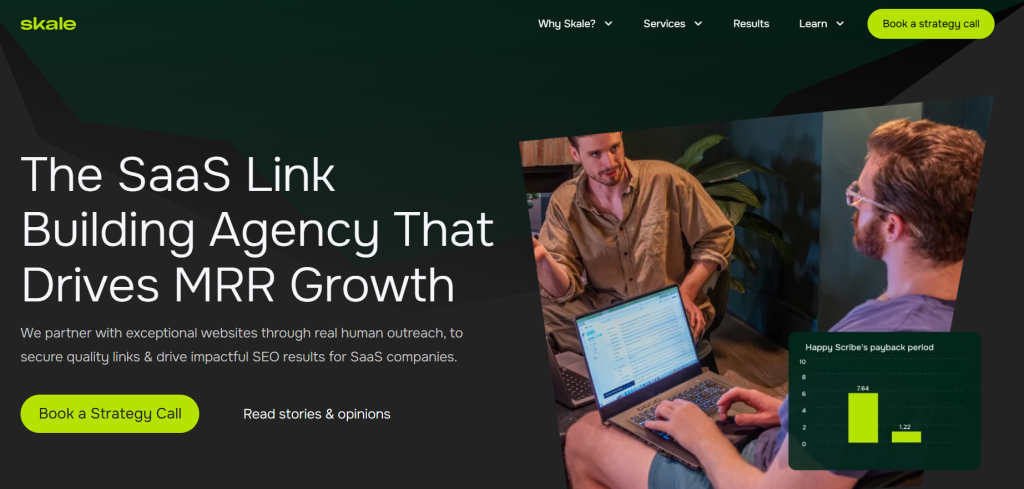
Company Overview: Skale is a SaaS marketing agency pairing traditional SEO and link building with AI search optimization. It works exclusively with software companies, and published client examples include Pendo, Flodesk, and Dialpad.
Best For: SaaS companies that want a single growth partner rather than a standalone link vendor — particularly teams whose rankings are being held back by something other than links.
Core Services: Full-funnel SaaS SEO, link building, content strategy, AI search and LLM visibility work, technical SEO.
Industries Served: SaaS and technology exclusively. No local, e-commerce, or general business clients competing for team attention.
Outreach Quality: Link acquisition sits inside a broader strategy, so placements get chosen against revenue-relevant pages rather than link counts. That means fewer links than a pure link shop at the same spend, aimed at pages selected during strategy rather than by what’s easiest to pitch.
Reporting: Reporting ties back to MRR and pipeline rather than domain rating movement — one of the few agencies that reports at that level by default. Expect keyword movement on target URLs, organic session data, and revenue attribution rather than a list of placements.
Pricing: Custom pricing based on growth goals, market, and current visibility across both traditional and AI search. Quote only — pricing not published.
| ✅ Pros | ❌ Cons |
| SaaS-exclusive client base | No published pricing to benchmark |
| Reports against revenue, not vanity metrics | Overkill if you only need links |
| Established AI search capability | Broader scope means higher total cost |
| Named, verifiable SaaS clients | Harder to test with a small first order |
Why Choose Them: Most stalled link campaigns aren’t link problems. They’re targeting, content, or technical SEO problems that more links can’t fix. A combined engagement addresses the actual constraint. The tradeoff is that you’re buying a full program, not a line item.
7. SAASY LINKS — Best Pure SaaS Link Specialist
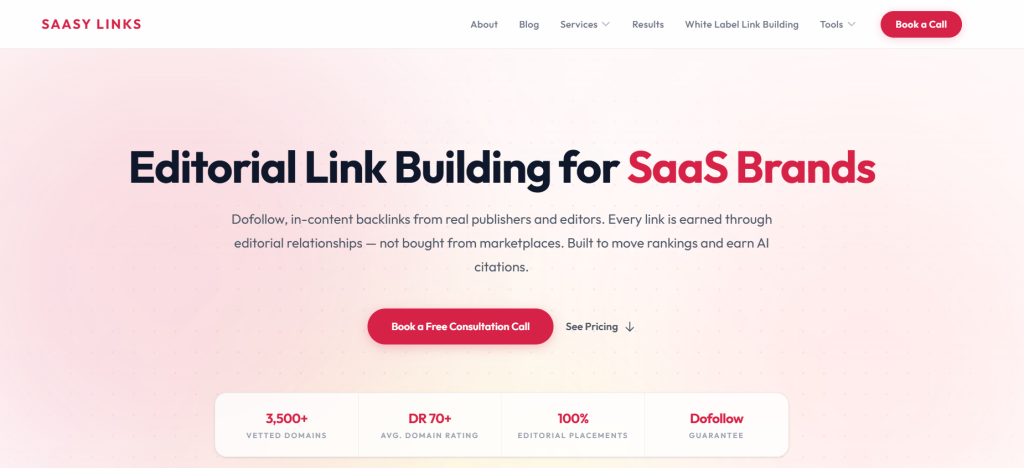
Company Overview: SAASY LINKS works exclusively with SaaS brands and states it has built more than 10,000 links for over 100 SaaS companies. It publishes detailed pricing research on the category — a reasonable proxy for how well a provider understands its own market.
Best For: SaaS companies that want a dedicated link partner with no non-SaaS clients in the queue, and teams prioritizing AI search visibility alongside rankings.
Core Services: Editorial link building, guest posts, listicle placements, digital PR, AI visibility support.
Industries Served: B2B SaaS only.
Outreach Quality: Focused on editorial placements and listicle inclusion — the “best [category] tools” and “alternatives to X” pages that AI search engines pull from when recommending software. That focus is more deliberate than most competitors, who treat listicle placement as incidental.
Reporting: Standard placement reporting with live URL verification and anchor tracking. Less detailed than Skale’s revenue reporting, more detailed than a marketplace order sheet.
Pricing: Quote only — pricing not published. Its own published research puts the SaaS agency market at $2,000–$15,000 per month, which is a reasonable expectation band.
| ✅ Pros | ❌ Cons |
| SaaS-only specialization | No published pricing |
| Listicle focus supports AI visibility | Smaller team than the larger agencies |
| Strong published category research | Limited independent review volume |
| Clear grasp of SaaS page targeting | Not suitable for non-software clients |
Why Choose Them: Listicle placements matter more in 2026 than they did two years ago. Getting into the roundups that rank for “best [your category] software” directly affects whether AI assistants name your product when a buyer asks.
8. Page One Power — Best for Long-Term Programs
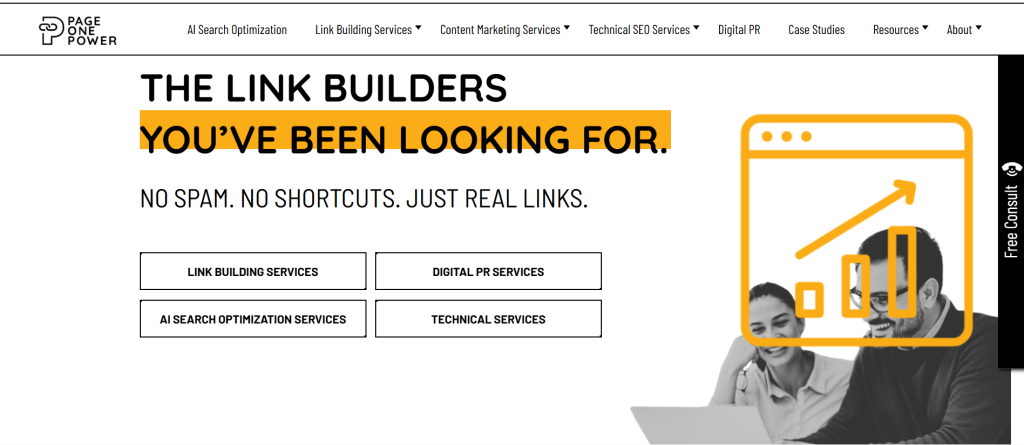
Company Overview: Operating since 2010 out of Boise, Idaho, Page One Power is one of the longest-running manual outreach agencies in the US market. It specializes in durable, editorially earned links built to survive algorithm updates.
Best For: Established SaaS companies building authority over 12 months or more.
Core Services: Custom link strategy, managed content and outreach, resource link building, retainer and project options.
Industries Served: Broad — SaaS, education, healthcare, e-commerce, enterprise.
Outreach Quality: Genuinely manual, with strategy built per client rather than productized. The long operating history means established publisher relationships.
Reporting: Full transparency on every placement, including sites contacted and the rationale for each.
Pricing: Custom retainers. Third-party analysis reports monthly retainers beginning in the low four figures and scaling into five figures for competitive niches.
| ✅ Pros | ❌ Cons |
| 15+ year track record | Slower turnaround than most competitors |
| Links hold through algorithm updates | Higher minimum investment |
| Transparent placement reporting | Less SaaS-specific than dedicated providers |
| Real strategy, not a productized package | Better suited to established brands |
Why Choose Them: Longevity is a real signal here. An agency that survived every major link spam update since 2010 has been doing something structurally sound.
9. Stellar SEO — Best for Regulated and Niche Verticals
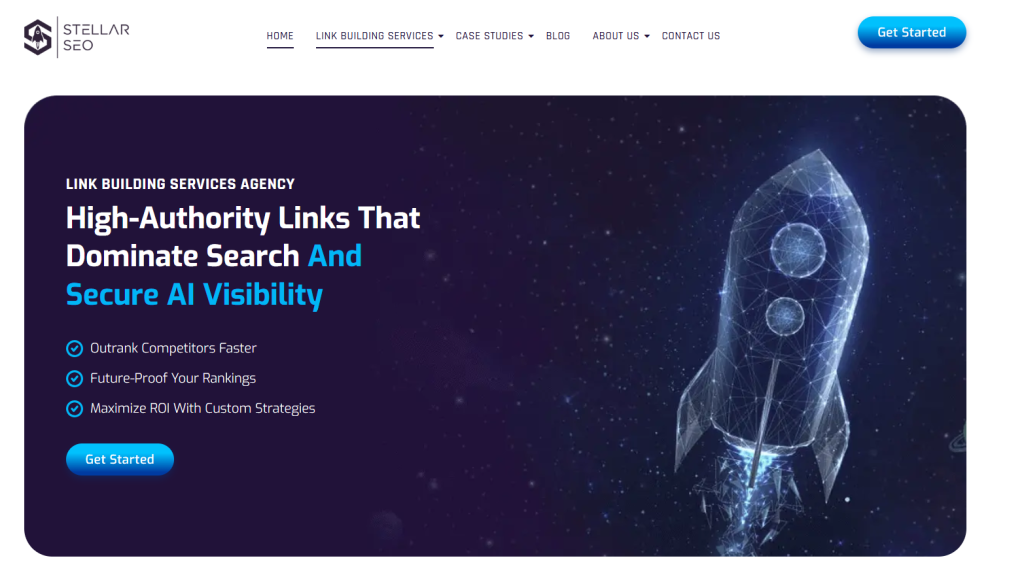
Company Overview: Stellar SEO takes a boutique, relationship-first approach, building direct editor relationships to earn contextually relevant placements. It publishes substantial open research on link-building pricing, which suggests unusual candor about market economics.
Best For: SaaS companies selling into regulated or highly technical verticals — legal tech, health tech, fintech, insurtech — where a generic SaaS placement carries no weight with the audience or the SERP.
Core Services: Custom outreach campaigns, guest posts, niche edits, resource link building, link building strategy consulting.
Industries Served: Legal, healthcare, finance, SaaS, professional services. Vertical depth is the point here rather than breadth.
Outreach Quality: Custom outreach rather than templated blasts, with senior team oversight on campaigns. Prioritizes topical relevance over domain metrics — a meaningful distinction in YMYL-adjacent categories, where Google applies extra scrutiny and a link from an unrelated business blog does close to nothing.
Reporting: Placement reporting plus campaign strategy documentation explaining why each target was selected. Slower and more manual than dashboard-based providers, which suits the campaign type.
Pricing: Quote only — pricing not published. The company publishes market benchmarks openly, so the sales conversation tends to start from realistic numbers.
| ✅ Pros | ❌ Cons |
| High contextual relevance on placements | Smaller scale than larger agencies |
| Relationship outreach reduces spam risk | Higher cost per link than volume services |
| Publishes honest market pricing research | Longer onboarding period |
| Strong in regulated and technical niches | No published rates |
Why Choose Them: If you sell into healthcare or finance, generic SaaS placements won’t carry the trust signals those SERPs demand. Vertical depth is worth paying for.
10. Outreach Monks — Best for Predictable Monthly Delivery
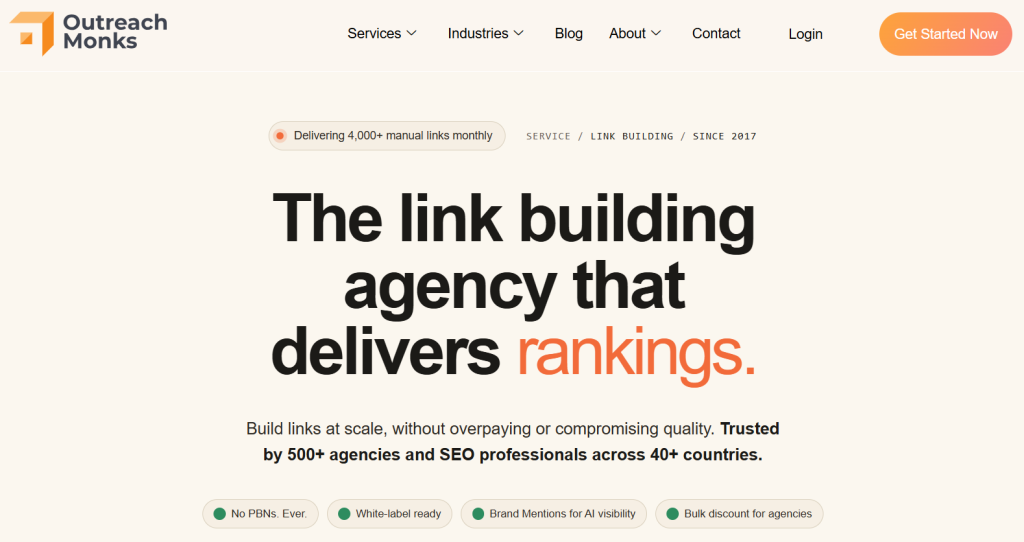
Company Overview: Founded in 2017, Outreach Monks delivers managed guest posts and niche edits through manual outreach, priced by DR tier. It has become a dependable mid-market option for teams wanting done-for-you delivery without a heavy retainer.
Best For: SaaS teams and agencies that want steady, predictable link delivery on a set monthly cadence, without the volatility of credit models or the commitment of premium retainers.
Core Services: Guest posts, niche edits, managed monthly packages, DR-tiered placements.
Industries Served: SaaS, B2B, e-commerce, general business. Not a specialist, but the publisher network covers software categories adequately.
Outreach Quality: Manual outreach with DR-tiered options. Quality sits squarely mid-market — better than marketplace inventory, below premium editorial shops. Independent reviews note some quality variance between tiers, so specify your minimum traffic threshold in writing rather than relying on the DR label.
Reporting: Includes built-in rank tracking and a live Google Sheet reporting layer — a genuine advantage at this price point, where most competitors hand over a list of URLs and leave you to work out whether anything moved.
Pricing: Packages priced by DR tier. Quote only for current tiers — confirm directly, as published tiers have changed.
| ✅ Pros | ❌ Cons |
| Rank tracking built into reporting | Not SaaS-specialized |
| Predictable monthly package structure | Quality varies across DR tiers |
| Faster turnaround than premium agencies | Less strategic input than a true partner |
| Reasonable mid-market pricing | Site pre-approval not standard |
Why Choose Them: The included rank tracking closes the measurement gap that makes mid-market link buying so hard to justify internally. If you need to show a founder what $2,500 a month bought, this makes that conversation easier.
11. Loganix — Best White-Label Supply
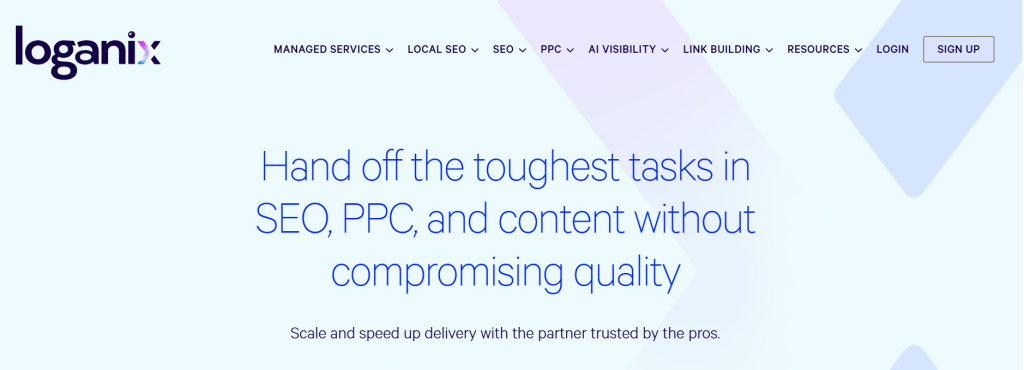
Company Overview: Loganix is a fulfillment-first provider used heavily by SEO agencies managing client campaigns. It offers self-serve ordering across 15+ services with a subscription option, and allows domain approval before placement.
Best For: Agencies and in-house teams needing reliable link supply without strategic hand-holding.
Core Services: Guest posts, niche edits, brand links, HARO-style media placements, Reddit marketing, press releases, content.
Industries Served: Broad — agency clients across most verticals.
Outreach Quality: Manual vetting with domain approval before placement, uncommon at this price tier. Independent comparisons note it avoids the low-quality placements that affect some volume competitors.
Reporting: Self-serve dashboard with order tracking, review, approval, and replacement requests.
Pricing: Guest posts from approximately $200 per link. Some self-serve services start as low as $7. Subscription and per-order options available.
| ✅ Pros | ❌ Cons |
| Domain approval before placement | Limited strategic guidance |
| Consistent quality for the price tier | Turnaround can extend past 30 days |
| Self-serve — no sales call required | Not SaaS-specialized |
| Free account to browse services | Wrong fit if you need a partner |
Why Choose Them: If you already know what links you need and want a dependable supplier, this removes the retainer overhead entirely.
12. RankUp4U — Best for Early-Stage SaaS Wanting Bundled SEO
Full disclosure: this is our agency. We placed ourselves at #12 rather than #1 because the criteria above reward published pricing, verifiable case studies, and public sample placements — and several specialists here publish more than we currently do. Here’s an honest assessment.
Company Overview: RankUp4U is a full-service SEO agency working with businesses worldwide on organic growth. Link building sits alongside on-page SEO, technical SEO, keyword research, and auditing rather than operating as a standalone product.
Best For: Early-stage and seed-stage SaaS companies that need the foundation fixed at the same time as links, and can’t justify a $3,000/month link-only retainer yet.
Core Services: Link building, off-page SEO, on-page SEO, technical SEO, keyword research, SEO audits, marketing strategy.
Industries Served: Broad — SaaS, e-commerce, local business, professional services. We are not a SaaS-exclusive agency.
Outreach Quality: Manual outreach, white-hat only, no PBNs. We build to money pages rather than defaulting to blog posts.
Reporting: Monthly reporting covering live placements, anchor distribution, ranking movement, and organic traffic on target URLs.
Pricing: Quote only — custom pricing available upon request.
| ✅ Pros | ❌ Cons |
| Links, on-page, and technical SEO in one engagement | Not a SaaS-exclusive specialist |
| Accessible entry point for pre-Series A budgets | No published pricing — you have to ask |
| Direct access to the strategist on your account | No public SaaS case studies yet |
| No long lock-in contract | Smaller team than the agencies above |
Why Choose Them: Most link building failures we see aren’t link problems — they’re crawlability, thin content, or wrong-page targeting, and buying more links fixes none of them. If all three need work, a bundled engagement costs less than hiring a link specialist and a technical SEO separately. If you’re past Series A with a clean site and just need volume, a specialist ranked above us is the better call. You can review our work before deciding.
13. The HOTH — Best Low-Cost Entry Point
Company Overview: Founded in 2010 in St. Petersburg, Florida, The HOTH is one of the largest US SEO service providers, running a storefront-style catalog alongside a managed option.
Best For: SaaS teams testing link building on a small budget, and agencies reselling at margin.
Core Services: Eight ala carte link products covering manual outreach, link insertions, premium editorial placements, news distribution, plus fully managed HOTH X.
Industries Served: Very broad — local, e-commerce, SaaS, general business.
Outreach Quality: DA-tier based, and this is the main caveat. DA tiers don’t guarantee real organic traffic, and independent auditors report quality varying within the same tier. Check every placement’s traffic in Ahrefs or Semrush before counting it.
Reporting: Well-built dashboard with white-label reporting for resellers.
Pricing: Guest posts reported from ~$150–$175 by DA tier. Link insertions around $200. Content syndication from $99, press releases from $150. HOTH X managed campaigns reported from around $1,000/month.
| ✅ Pros | ❌ Cons |
| Lowest managed-service entry price | Quality inconsistent within DA tiers |
| Transparent published product pricing | Not SaaS-specific |
| Strong white-label reporting | Frequent upsell prompts |
| 15-year operating history | Some reviewers dispute link quality outright |
Why Choose Them: Fine as a low-risk first test. Not where you build a serious authority program.
14. FATJOE — Fastest Turnaround
Company Overview: Founded in 2012 by Joe Davies, FATJOE is a UK-based white-label marketplace serving agencies, freelancers, and business owners on a per-order basis with no retainer.
Best For: Agencies needing fast, cheap volume, and teams filling gaps in an existing profile.
Core Services: Blogger outreach, niche edits, brand mentions, media placements, press releases, local citations, content writing.
Industries Served: All verticals via marketplace inventory.
Outreach Quality: The weakest area on this list, and worth reading carefully. Pricing is tiered strictly by DR, and you cannot select specific publications. One detailed independent review documented paying roughly $127 for a placement available for $35 elsewhere, and questioned whether “blogger outreach” placements were genuinely earned through outreach.
Reporting: Order dashboard with placement URLs.
Pricing: Blogger outreach from ~$83–$85 for DR10+, rising to roughly $675+ for top tiers. Niche edits from ~$81. Bundles reported at 5 links for $695. Media placements to $7,800+.
| ✅ Pros | ❌ Cons |
| Fastest delivery here (5–10 days) | You can’t choose specific sites |
| Fully transparent tier pricing | DR tiers don’t guarantee real traffic |
| No minimum commitment | Independent reviews raise quality concerns |
| Strong white-label infrastructure | Not suited to premium authority building |
Why Choose Them: Speed and price, with real quality tradeoffs you should price in before ordering.
15. Fractl — Best for Digital PR and Original Research
Company Overview: Fractl builds high-authority links through original research, surveys, and data studies designed to be cited by journalists, targeting mainstream publications rather than niche blogs.
Best For: Well-funded SaaS brands running brand-building campaigns aimed at Tier 1 media coverage.
Core Services: Original research design, survey production, data studies, journalist and media outreach.
Industries Served: Broad consumer and B2B brands with newsworthy data.
Outreach Quality: Genuine earned media. Placements come from editorial decisions rather than placement fees, making them among the most durable links available.
Reporting: Campaign-level reporting on placements, reach, and coverage.
Pricing: Quote only. Digital PR campaigns across the industry typically run $3,000–$15,000+ per month.
| ✅ Pros | ❌ Cons |
| Highest possible placement authority | Enterprise pricing only |
| Genuine earned media, not paid placement | Results depend partly on the news cycle |
| Research is reusable as a marketing asset | Poor fit for narrow technical niches |
| Links are extremely durable | Longest timeline of any option here |
Why Choose Them: When you need a link from a publication your investors have heard of, and you have data worth publishing, this is the category that delivers it.
Also Worth Considering
These didn’t make the main list but fit specific situations: Above Apex (SaaS-focused, publishes rates at $400–$520 per link or $3,500/month for 8 placements), Digital Olympus (reported $500–$900 per link with a pre-vetted publisher network), Stan Ventures and Rhino Rank (lower-cost DR-tiered placements), Digital Current (enterprise SaaS SEO with links integrated into broader strategy), and NUOPTIMA (growth-stage B2B).
SaaS Link Building Pricing in 2026
Quality backlinks cost between $220 and $2,000 per link in 2026, depending on method and publisher authority. Most SaaS companies spend $3,000 to $10,000 per month on link building.
Third-party research supports those bands. Ahrefs reports an average paid backlink cost of roughly $361 when buying directly from site owners, before labor. BuzzStream’s analysis found higher-quality sites with real organic traffic average around $609 per link. uSERP’s State of Link Building research found companies willing to pay an average of $508.95 for a quality backlink, with 46.5% of respondents spending $5,000–$10,000 monthly and 18% spending more than $10,000. Editorial.Link’s research found 80.9% expect costs to rise further over the next two to three years.
Pricing by Link Type
| Link Type | Typical Cost | Turnaround | Durability | Risk Level |
| Guest post (DR30–50) | $220–$600 | 30–45 days | High | Low |
| Niche edit/link insertion | $150–$400 | 14–30 days | Medium | Low–Medium |
| Editorial placement (DR50+) | $350–$1,000 | 30–60 days | Very high | Low |
| Listicle placement | $350–$750 | 30–45 days | High | Low |
| Digital PR link | $750–$2,000+ | 60–120 days | Very high | Low |
| Marketplace bulk link | $50–$150 | 5–10 days | Low | High |
Budget by Company Stage
| Stage | Monthly Budget | Links/Month | Realistic Goal | Time to Impact |
| Pre-seed / bootstrapped | $0–$1,500 | 0–3 | Build content first | N/A |
| Seed | $1,500–$3,000 | 3–6 | Baseline authority on 5–10 pages | 6–9 months |
| Series A | $3,000–$8,000 | 8–15 | Compete for mid-competition keywords | 4–6 months |
| Series B+ | $8,000–$25,000 | 20–50 | Defend positions, win head terms | 3–6 months |
In-House vs. Agency vs. Freelancer vs. Marketplace
| Model | Monthly Cost | Speed | Quality Control | Best For |
| In-house team | $8,000–$15,000+ in salary and tools | Slow to start | Highest | $10M+ ARR with volume needs |
| Specialist agency | $2,000–$15,000 | Medium | High | Most funded SaaS companies |
| Freelancer | $1,000–$4,000 | Variable | Variable | Small, defined projects |
| Marketplace | $500–$3,000 | Fastest | Lowest | Filling gaps, agency resale |
The in-house math surprises people. Between a link-building manager, an outreach assistant, a writer, and tool licenses for Ahrefs or Semrush, a lean internal team runs well past $90,000 a year and typically produces fewer links than a specialist agency at half the cost.
Guest Posts vs. Niche Edits vs. Digital PR
Guest posts publish new content on a third-party site with your link inside. Niche edits add your link to an article that’s already published and indexed. Digital PR earns links by giving journalists original data worth citing.
| Factor | Guest Post | Niche Edit | Digital PR |
| How it works | New article written and placed | Link inserted into existing content | Original research pitched to media |
| Typical cost | $220–$600 | $150–$400 | $750–$2,000+ |
| Speed to live | 30–45 days | 14–30 days | 60–120 days |
| Control over context | High | Medium | Low |
| Speed of ranking impact | Medium | Faster (page already indexed) | Slower, then compounds |
| Best use | Building topical relevance | Boosting a specific target URL | Brand authority and Tier 1 links |
Most SaaS programs use all three: niche edits to push a specific comparison page, guest posts to build category relevance, and digital PR once or twice a year for authority.
How to Choose a SaaS Link Building Agency
Follow these seven steps to choose a SaaS link building agency:
- Fix your foundation first. Confirm the site is crawlable in Google Search Console and you have 10–20 substantial pages worth linking to.
- Pick your target pages. List the feature, integration, and comparison URLs that drive signups.
- Run a competitor link gap analysis. Find where your top three competitors earn links. That’s your prospect list.
- Set a realistic budget. Use the stage table above. Underfunding wastes the entire budget.
- Request sample placements. Ask for five live links from clients in a similar niche and check each site’s organic traffic yourself.
- Ask the twelve questions below. How a provider answers matters more than what they pitch.
- Start small and verify. Buy a small first order where possible, audit the placements, then commit.
12 Questions to Ask Before You Sign
- Which specific pages will you build links to, and why those?
- Can I see five recent live placements from a similar client?
- Do I approve each publisher before outreach begins?
- How do you verify a site has real organic traffic, not just a high DR?
- Who writes the content — your team, mine, or the publisher’s?
- What happens if a link is removed or the page is deindexed?
- What’s the minimum commitment, and what’s the exit process?
- How many other clients do you serve in my exact category?
- What does the monthly report include beyond a list of URLs?
- How do you measure success — DR, rankings on target URLs, or organic sessions?
- Do you use PBNs, link networks, or paid placements? Ask directly.
- What’s the realistic timeline before I see ranking movement?
Any provider that gets defensive about question 2, 3, or 11 has told you what you need to know.
Contract Terms Most Buyers Forget to Check
Pricing gets all the attention. These clauses decide what happens when something goes wrong.
- Minimum commitment. Three and six-month minimums are common at the premium tier. Editorial.Link and Loganix have none. Know which you’re signing.
- Link replacement policy. If a placement is removed or the page is deindexed at month four, does the agency replace it free? Policies range from none to two years.
- Ownership of content. Guest post articles are usually written by the agency. Confirm you can reuse them.
- Notice period. Thirty days is standard. Sixty is a flag on a first engagement.
- Placement approval rights. Get it in writing, not just in the sales call.
- Reporting cadence and format. Specify what the report must contain, or you’ll get a spreadsheet of URLs.
- Category exclusivity. Ask whether the agency serves a direct competitor. Most won’t offer exclusivity, but the answer is informative.
8 Red Flags to Avoid
Watch for these warning signs when evaluating a link building provider:
- Guaranteed rankings. Nobody can guarantee a position. Google doesn’t sell them.
- Prices under $50 per link. These come from link farms and PBNs, both explicit violations of Google’s link spam policies.
- Refusal to name placements. “We can’t share client sites” usually means the sites won’t survive inspection.
- DR sold without traffic data. A DR60 site with 200 monthly visitors is a metrics-inflation site.
- Bulk packages with round numbers. “100 links for $499” is a marketplace dumping inventory, not outreach.
- No pre-placement approval. If you can’t approve sites before outreach, you’re trusting a stranger with your domain.
- Reporting that stops at link counts. A report with no ranking or traffic data is a receipt.
- Sites selling links openly. A publisher with a “write for us — $200” page sells to your competitors too. That link isn’t editorially earned.
Common SaaS Link Building Mistakes
Beyond vendor selection, these are the errors we see most:
- Building only to blog posts. Feature and comparison pages need equity too — they’re the ones that convert.
- Chasing DR over relevance. A relevant DR35 usually beats an irrelevant DR70 for SaaS keywords.
- Inconsistent link velocity. Fifty links one month and none for six looks unnatural.
- Ignoring anchor text distribution. Exact-match anchors above roughly 10% of your profile is a pattern Google notices.
- Skipping competitor analysis. Build where competitors already have links. That’s your proven gap.
- Measuring the wrong thing. Domain rating is a third-party score, not a Google metric.
- Expecting results in 30 days. Movement typically takes 3–6 months, longer for competitive terms.
How to Measure Link Building ROI
Domain rating is not a business metric. Track these five instead:
| Metric | Where to find it | What good looks like |
| Rank movement on target URLs | Ahrefs, Semrush, or Search Console | Steady climb on the specific pages you linked to |
| Organic sessions on those pages | Google Search Console | Month-over-month growth after month three |
| Referring domain growth | Ahrefs or Majestic | Unique domains rising, not just total links |
| AI citation appearance | Manual testing in ChatGPT and Perplexity | Brand named in buyer-intent answers |
| Assisted signups | GA4 with tagged organic sessions | Trials attributable to target pages |
The formula: ROI = (Revenue growth from organic traffic − Link building costs) ÷ Link building costs × 100%
A worked example. Say you spend $5,000 a month for six months — $30,000 total. Your target comparison page moves from position 14 to position 4 and organic sessions rise from 300 to 1,900 a month. At a 3% trial conversion rate and $2,400 annual contract value, those 1,600 extra sessions produce roughly 48 trials. At a 20% trial-to-paid rate, that’s about 9 customers, or $21,600 in new annual recurring revenue from one page — with the ranking still in place next year.
That’s the math that justifies the spend. Run it on your own numbers before signing, not after.
Frequently Asked Questions
How much do SaaS link building services cost?
Most SaaS companies spend $3,000 to $10,000 per month. Individual links typically cost $220 to $600 for guest posts, $350 to $1,000 for editorial placements, and $750 to $2,000+ for digital PR. Research from uSERP found 46.5% of companies spend $5,000 to $10,000 monthly on links alone.
How long does SaaS link building take to show results?
Expect early ranking movement in 6 to 12 weeks and compounding impact at 3 to 6 months. Competitive head terms can take 9 to 12 months. Long-tail keywords respond fastest.
Is buying backlinks against Google’s guidelines?
Paying specifically for links that pass ranking credit violates Google’s link spam policies. In practice, much of the industry operates in a gray area where content and placement fees are involved. The safest approach is earned editorial placements and digital PR, where the publisher chooses to link.
How many backlinks does a SaaS company need to rank?
There’s no fixed number. Check how many referring domains the pages currently ranking in the top three have for your target keyword, then plan to close roughly that gap over 6 to 12 months.
What’s the difference between a guest post and a niche edit?
A guest post publishes new content on a third-party site with your link inside it. A niche edit adds your link to an already-indexed article. Niche edits often move rankings faster because the page has existing authority; guest posts give you more control over context.
Should I hire an agency or build links in-house?
Below $10M ARR, an agency is almost always cheaper. A lean in-house team — manager, assistant, writer, tools — costs $90,000+ per year and usually produces fewer links than a $5,000/month retainer.
Which pages should SaaS companies build backlinks to?
Feature pages, integration pages, comparison pages, and “alternatives to X” pages. These sit closest to a signup. Most agencies default to blog posts because they’re easier to pitch, which is why so many campaigns produce authority without pipeline.
What DR should I look for in a backlink?
Don’t lead with DR. Check organic traffic first — a DR60 site under 1,000 monthly visitors passes very little value. Then check topical relevance. A relevant DR35 site typically outperforms an irrelevant DR70.
Do backlinks help with visibility in ChatGPT and AI Overviews?
Yes, indirectly. AI answer engines pull from sources they trust, particularly listicles, comparison pages, and editorial coverage. Products mentioned across multiple trusted roundups get cited more often, which is why listicle placements have gained value.
Can link building hurt my SaaS website’s rankings?
Yes. Links from PBNs, link farms, and bulk marketplaces can trigger algorithmic devaluation or, less commonly, a manual action. Cleanup costs more time and money than doing it properly the first time.
What should be in a monthly link building report?
Live placement URLs, anchor text used, target page for each link, referring domain metrics including organic traffic, ranking movement on target URLs, and organic session change. A list of URLs alone isn’t a report.
Is link building worth it for a pre-revenue SaaS startup?
Usually not yet. Without a content foundation and validated positioning, links have nothing to amplify. Spend on product, positioning, and 10 to 20 solid pages first.
Final Verdict
There isn’t one best SaaS link building service. There’s a best fit for your stage and budget.
Want maximum transparency and no commitment? Start with Editorial.Link. Published pricing, site pre-approval, and no minimum retainer make it the easiest provider here to test at low risk.
Funded and chasing authority? uSERP and Siege Media operate at the top of the market. They cost more and move slower, and the placements justify both.
Want a SaaS-only specialist? dofollow.com, SAASY LINKS, and Skale build exclusively for software companies and understand the page targeting generalists get wrong.
Selling into a regulated vertical? Stellar SEO’s relevance-first approach fits legal, health, and fintech better than volume providers.
Early-stage with an unfinished foundation? A bundled engagement usually delivers more than a link-only retainer at the same price.
Need volume fast and accept the tradeoffs? The HOTH and FATJOE deliver quickly and cheaply.
Whatever you choose, do three things before signing: request five live sample placements, verify their organic traffic yourself, and confirm which specific pages the agency plans to target. Providers who welcome that scrutiny are the ones worth hiring.
Not Sure Which Tier Fits Your Site?
Most SaaS companies we talk to don’t have a link problem. They have a targeting problem — links pointing at blog posts instead of the pages that convert, or a technical foundation that isn’t ready to hold them.
If you’d like a second opinion before committing budget, get a free SEO audit. We’ll review your backlink profile, identify which competitors are outpacing you and where, and tell you honestly whether link building is your next best investment or whether something else should come first.
No obligation, and no pitch if the answer is that you’re not ready yet.