
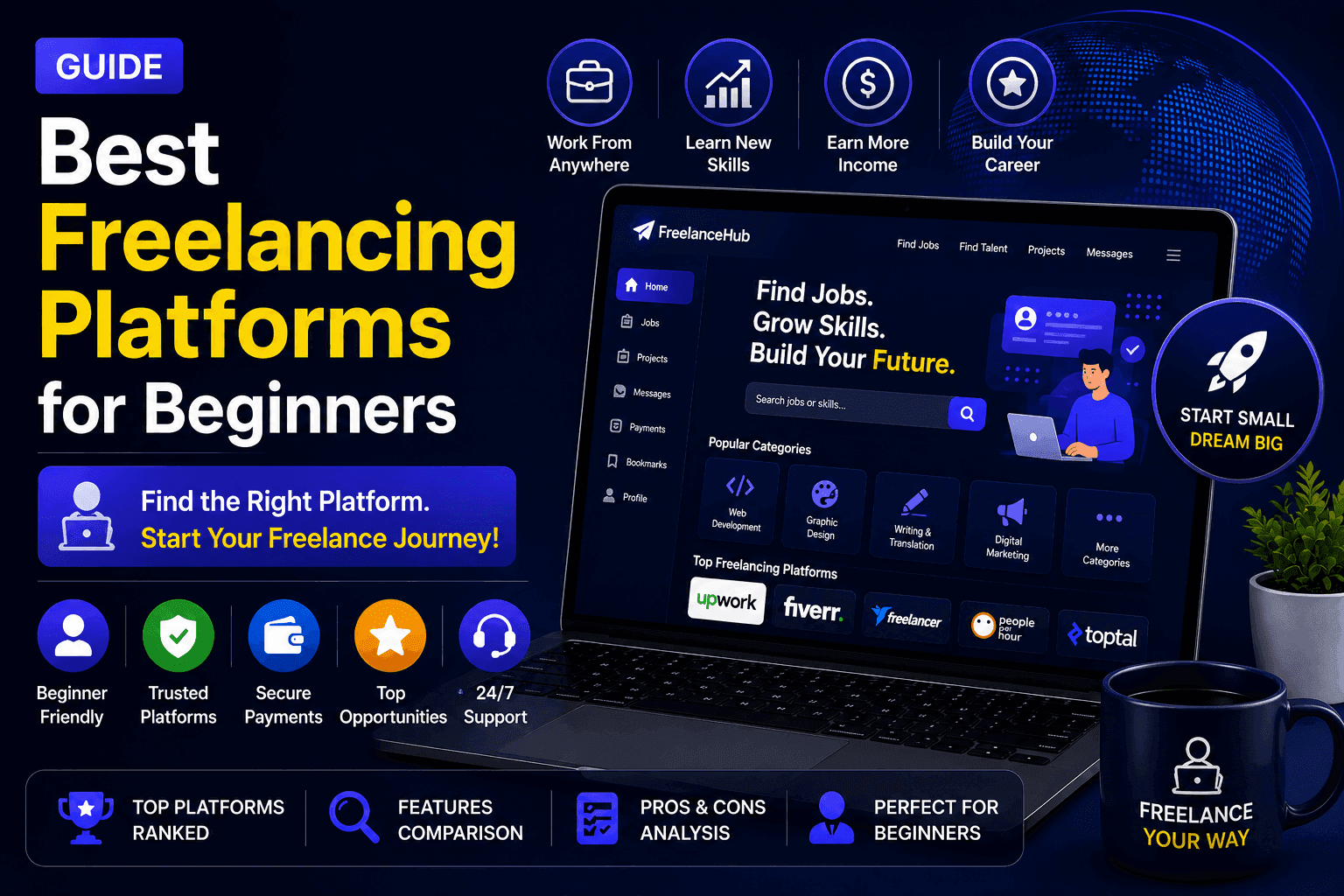
Freelancers now report more work opportunities than full-time employees do. In Upwork’s 2026 Future Workforce Index, 89% of freelancers said they had more opportunities than a year earlier, compared to 70% of traditional employees. Statista projects the US freelance workforce will hit 86.5 million people, over half the workforce, by 2027.
That growth is exactly why the choice of platform matters so much when you’re starting. The wrong one can bury a beginner under fees and competition before a single dollar comes in. The right one gets you a paying client in your first week.
This guide breaks down what each major platform actually costs, who it’s realistically good for, and the mistakes that trip up most new freelancers before they land their first job.
How We Evaluated These Platforms
Every platform below was assessed on four things that matter most to someone with no reviews and no track record yet: how easy it is to get your first job, what the platform actually takes from your pay, how the payment protection works, and whether beginner-level work genuinely exists there or if it’s dominated by established freelancers. Fee figures are checked against each platform’s own published rates; where sources disagreed, we noted the range rather than picking a single number.
What Beginners Actually Pay: A Real Fee Comparison
Fee structures are the first thing that trips people up, mostly because platforms rarely put the real numbers next to each other. Here’s the current picture.
| Platform | What You Pay | Payout Speed | Beginner Access |
|---|---|---|---|
| Upwork | Variable 0-15% per contract, most freelancers land around 10% | 5-10 days after approval | Open, but you compete for jobs using paid “Connects” |
| Fiverr | Flat 20% on every order, including tips | 14 days (7 for Top Rated Sellers) | Open, no bidding required |
| Freelancer.com | Roughly 10% or a flat minimum, whichever is higher | Varies by milestone | Open, bid-based |
| Guru | Free membership available; paid tiers unlock more bids | Escrow-based, released on approval | Open |
| Contra | 0% commission on your rate | Direct to your bank via Stripe | Open, but far fewer active job listings than Upwork or Fiverr |
| Toptal | No direct cut from your rate; the company builds its margin into what it charges clients | Per contract terms | Closed. Only the top 3% of applicants pass screening |
| FlexJobs | You pay to join (roughly $9-25/month depending on plan length), not the client | N/A, it’s a curated job board | Open to subscribers, listings hand-screened for legitimacy |
A quick gut check most people skip: run your expected monthly earnings through the fee percentage before you commit time to a platform. A 20% cut sounds abstract until you see that $2,000 in gigs nets $1,600, not $2,000.
The Best Freelancing Platforms for Beginners in 2026
Upwork: The Widest Net
Upwork is still the largest general marketplace, and that scale is its real advantage for a beginner: there’s an entry-level job posted in nearly every category, every day. The catch is Connects, the paid bidding currency you spend on every proposal whether or not you win the job. Beginners who apply to everything burn through Connects fast with little to show for it. Beginners who research five jobs closely and write a specific, tailored pitch tend to convert far better than beginners who send twenty generic ones.
Upwork moved to a variable 0-15% service fee per contract in 2025, replacing its older tiered system. Most freelancers land around 10%, but the exact rate is shown before you submit a proposal, so you can factor it into your pricing.
Best for: Beginners who want the largest possible pool of jobs and are willing to be selective and patient with proposals.
Fiverr: List a Service, Skip the Pitching
Fiverr flips the Upwork model. Instead of pitching for jobs, you list a specific “gig” at a fixed price and clients buy it directly. That removes the proposal-writing bottleneck entirely, which is why it’s often the fastest place for a total beginner to land a first sale.
The tradeoff is a flat 20% commission on everything, including tips, and a 14-day hold before funds clear (7 days once you reach Top Rated Seller status). Narrow, specific gigs (“I will edit your 1,500-word blog post for SEO”) consistently outperform broad ones (“I will do writing”) because they match exactly what a searching buyer typed in.
Best for: Beginners who want to start selling immediately without writing proposals, and who can price a specific, well-defined service.
Freelancer.com: Bidding Plus Contests
Freelancer.com works like Upwork’s bidding model with one addition: skill contests, where you submit work on spec and the client picks a winner. For a beginner with no reviews yet, a contest is a way to get eyes on your work without needing a track record first, even if you don’t win every one you enter.
Best for: Beginners who want an alternate bidding pool to Upwork, or who want contest-based exposure while they build reviews.
PeoplePerHour: Bidding and Fixed Offers in One Place
PeoplePerHour blends Upwork’s bidding system with Fiverr’s fixed-price “Offers,” so you can apply for posted projects and sell predefined services from the same profile. New freelancers get a limited number of free monthly bids, which forces some discipline: you can’t blanket-apply, so pick jobs you’re actually qualified for.
Best for: Beginners who want the flexibility to both pitch for projects and sell fixed-price services without maintaining two separate profiles.
Guru: Lower Pressure, Smaller Pool

Guru covers the same broad categories as Upwork and Freelancer.com, but with less name recognition, which cuts both ways. There’s less competition for entry-level jobs, but there’s also a smaller client base browsing the platform at any given time. Its WorkRoom tool bundles messaging, file sharing, and milestone tracking in one place, which is genuinely useful once you land a multi-part project.
Best for: Beginners who want a lower-competition alternative to Upwork without a steep learning curve.
Contra: Keep 100% of What You Bill
Contra takes a genuinely different approach: 0% platform commission on your earnings. Payments route through Stripe, so standard card processing fees still apply, but nothing goes to Contra itself. The real limitation is volume. Contra’s client base skews toward startups and design or development work, and it’s a fraction of the size of Upwork’s or Fiverr’s. It works best as a second platform once you have a portfolio, not as your only source of jobs on day one.
Best for: Beginners with a strong portfolio already (even from personal or unpaid projects) who want to keep more of what they earn once work starts coming in.
Toptal: A Long-Term Goal, Not a First Stop
Toptal accepts roughly the top 3% of applicants who go through its screening, which includes technical tests and live interviews. It’s genuinely not built for someone with zero client history. What makes it worth knowing about early is its fee model: Toptal doesn’t take a cut from your rate the way Upwork or Fiverr does. It prices its margin into what clients pay. If you’re serious about freelancing long-term, building a portfolio on Upwork or Fiverr first, then applying to Toptal once you have real experience, is a realistic path.
Best for: Experienced or fast-improving freelancers with a portfolio ready, not someone applying in week one.
FlexJobs: You Pay, But Scams Are Filtered Out
FlexJobs flips the usual model: instead of the platform taking a cut of your earnings, you pay a subscription (roughly $9-25 a month depending on the plan) to access a job board where every listing has been manually screened for legitimacy. For beginners specifically worried about scam job postings, that vetting has real value. It won’t suit you if you want to browse for free or if you expect a large volume of listings; FlexJobs is intentionally curated and smaller than an open marketplace.
Best for: Beginners who are more worried about avoiding scams than about paying a small monthly fee.
Also Worth Knowing: Niche Platforms by Skill
If your skill fits a specific niche, a specialized platform can mean less competition than a general marketplace, even if the total number of jobs is smaller.
| Skill | Platforms Worth Checking |
|---|---|
| Writing | ProBlogger job board, Contena (paid, membership-based) |
| Design | Behance and Dribbble for portfolio-driven outreach, 99designs for contests |
| Development | Gun.io, TopCoder for competitive coding challenges |
| Tutoring | Wyzant (you set your own rate), Preply (strong for languages) |
| Virtual assistance | Belay, Time Etc |
A word of caution on this category: some once-popular niche platforms have quietly shut down or pivoted. VIPKid, long recommended for English tutoring, effectively ended its original teach-English-to-China model after a 2021 regulatory ban and now operates at a much smaller scale as VIPTeacher. Chegg discontinued its live one-on-one tutoring product entirely. Before you invest time building a profile anywhere, spend five minutes confirming the platform is still actively matching freelancers with paid work, not just still online.
3 Mistakes New Freelancers Make Choosing a Platform
Signing up everywhere at once. Spreading your first weeks across five platforms means a thin, unfinished profile on each one instead of one strong profile that actually converts. Pick one general platform and, if it fits your skill, one niche platform. Get your first few reviews before adding more.
Pricing to match the platform’s cheapest sellers. Undercutting everyone to win your first job is common advice, but bargain-basement pricing attracts clients who expect endless revisions for minimal pay. Price at a fair, sustainable rate and compete on a specific, well-written profile and portfolio instead.
Ignoring the fee before agreeing to a rate. A $30/hour rate on a platform that takes 20% is a $24/hour rate. Decide your real target take-home pay first, then work backward to the rate you list, factoring in whatever that specific platform charges.
FAQs About Freelancing Platforms for Beginners
Which platform is genuinely easiest to get a first client on?
Fiverr tends to be fastest for total beginners because clients search for and buy your gig directly, with no proposal or bidding process. A specific, narrowly defined gig with a clear price ranks and converts faster than a broad one.
Do I need a portfolio before I sign up?
For general marketplaces like Upwork or Fiverr, a few strong samples, even unpaid or personal projects, are enough to start. For portfolio-first platforms like Behance, Dribbble, or Contra, you’ll want a more developed body of work before you’ll see much traction.
Is it normal to apply to a lot of jobs before getting hired?
Yes. Most beginners apply for one to two weeks before landing a first paid job, and win rates improve significantly once you narrow your applications to jobs you’re genuinely qualified for instead of applying broadly.
Can I use more than one platform at the same time?
Yes, and many established freelancers deliberately do, since relying on a single platform means a single algorithm or policy change can cut off your income. Starting with one platform while you build your first reviews, then adding a second, is generally more effective than splitting your attention from day one.
Are freelance platform fees tax-deductible?
In most countries, platform service fees count as an ordinary business expense you can deduct from your freelance income, but confirm the specifics with a tax professional or your local tax authority since rules vary by country.
The Bottom Line
For most beginners, the realistic starting point is Upwork or Fiverr, not because they’re perfect, but because they have the client volume to get you a first review quickly. Once you have that review and a small portfolio, a lower-fee or niche platform like Contra, Guru, or a specialty site in your field starts to make a lot more sense. Pick one, price it honestly, and put in two focused weeks before judging whether it’s working.

Usama Bin Qasim is an SEO expert and content writer with 6+ years of experience in SEO and digital marketing. He writes practical SEO guides, SaaS and software reviews, tool comparisons, and digital marketing content based on hands-on research and real-world experience.