
Most SEO advice assumes a level playing field. Publish useful content, earn links, improve technically, and rankings follow in proportion to effort.
In regulated categories, the field is not level. Google applies additional scrutiny to topics that can affect a person’s health, finances, or legal position, and sites in those categories face a higher evidential bar for the same rankings. Understanding where that bar sits changes what you publish and in what order.
What Google is actually doing
The relevant framework is in Google’s Search Quality Rater Guidelines, which define a category the document calls Your Money or Your Life. Pages that could affect financial stability, legal standing, safety or wellbeing are held to a higher standard of expertise, experience, authoritativeness and trust.
Raters do not directly change rankings. What they do is evaluate whether the algorithm is producing results that meet the standard, and that feedback shapes subsequent iterations. The practical effect is that thin content in a YMYL category underperforms equivalent content in a low-stakes one, and the gap widens over time.
For anyone marketing in gambling-adjacent, financial, legal, or health categories, that is the environment.
Why thin content fails harder here
A generic 600-word product page can rank in an uncontested niche. The same page in a regulated category competes against government guidance, regulator publications, law firm content, and established trade press.
Those competitors have structural advantages — institutional authority, citations, domain history — that a commercial site cannot replicate directly. What it can do is produce content that is genuinely more useful to the specific question a user has, which usually means going deeper than the institutional sources rather than summarising them.
The failure mode is predictable. An operator publishes a short page targeting a commercial term; it does not rank, so they publish more short pages, and the aggregate signal gets worse rather than better.
What works instead: the reference page
The pattern that performs is a single, genuinely comprehensive page that answers a real question better than anything else available.
A useful example is the kind of legal guide operators in regulated sectors publish — a page explaining how to run a raffle legally in the UK rather than a thin page targeting a commercial term. It works for several reasons worth generalising:
It answers a question people actually have. The search intent is informational and specific, and the existing results are often regulator pages that are accurate but hard to apply.
It demonstrates expertise through specificity. General statements about legality are worthless. Detail about where exactly the line sits, what satisfies a requirement and what does not, is the thing that signals genuine knowledge.
It earns links without asking. Comprehensive reference content in a confusing area gets cited because it is useful, which is a materially different acquisition profile from commercial pages.
It supports the commercial pages internally. A guide that ranks and links through to the service page passes relevance and authority to the page you actually want to convert on.
The sequencing that works
Build the reference content before the commercial pages. The guide establishes the topical authority that the service page then benefits from. Doing it the other way round means the commercial page competes with no support.
Make it demonstrably current. Regulated topics change. A visible review date and genuine updates matter more here than in most categories, because currency is part of trustworthiness.
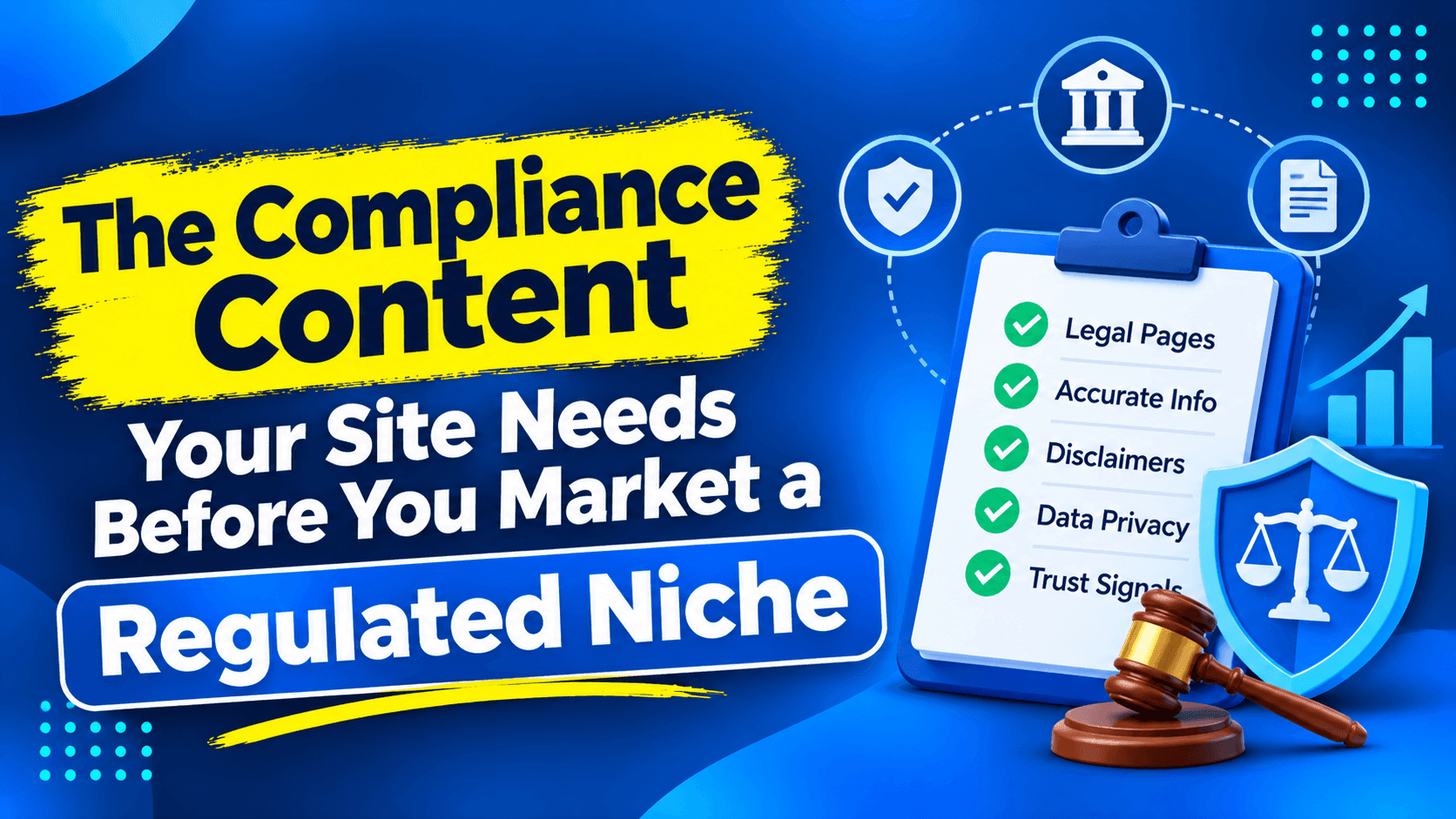
Attribute it properly. Named authors with relevant credentials, cited sources, and clear organisational information. The E-E-A-T guidance is explicit that who produced the content is part of how it is assessed.
Link out to authoritative sources. Citing the regulator does not send away traffic you were keeping. It demonstrates that the content sits in a real evidential context.
Then build the commercial pages, internally linked from the guides, targeting the terms that convert.
The measurement problem
Reference content does not perform like commercial content, and judging it on the same metrics leads people to abandon it early.
A guide may take months to rank, will attract informational traffic that converts poorly in isolation, and delivers most of its value indirectly — through links earned, authority passed internally, and the assisted conversions that attribution models tend to miss.
Measure it on rankings for the informational cluster, referring domains earned, and the performance of the commercial pages it links to. Measuring it on direct conversions will make a successful page look like a failure.
AI answers change the calculation again
Comprehensive reference content is also what gets cited in AI-generated answers. Pages that answer a specific question thoroughly are disproportionately represented in AI Overviews and assistant responses, while thin commercial pages are largely absent.
For regulated categories, this matters more than elsewhere, because users asking legal or financial questions increasingly get a synthesised answer rather than a list of links. Being the source that answer draws on is becoming a distinct acquisition channel.
The takeaway
Marketing a regulated niche is not standard SEO with extra caution. The evidential bar is higher, thin content underperforms more severely, and the content that works is informational rather than commercial.
Build the reference material first, make it genuinely better than what exists, attribute it properly, and let the commercial pages inherit the authority. It is slower than publishing service pages and waiting, and it is the approach that actually ranks.