
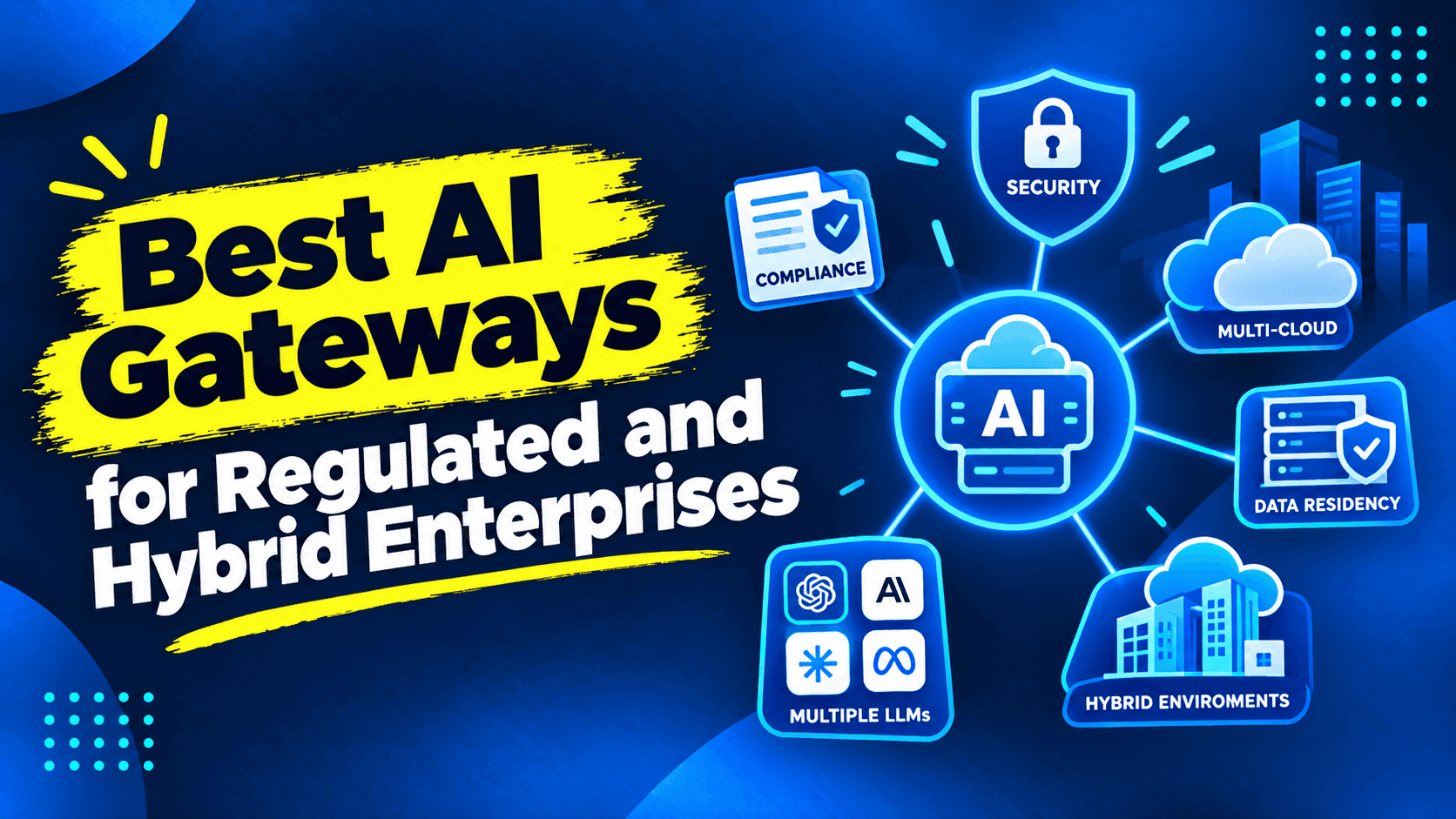
In a regulated enterprise, the hardest questions about an AI feature have nothing to do with the model. They are about where the data is processed, where prompts and logs are stored, who can access which capability, and whether you can prove all of it to an auditor. A bank, an insurer, or a healthcare provider often cannot send prompts through a multi-tenant SaaS in an unknown region, which rules out a surprising number of otherwise capable tools. The AI gateway is where these constraints get enforced, so choosing one is really a question of deployment model and governance depth.
This guide ranks five gateways for teams with hybrid, on-prem, or strict data-residency requirements, where “runs where we need it” is as important as any feature.
What regulated and hybrid teams need
The requirements that matter most here: a deployment model that can run in your own cloud, on-prem, or across a hybrid estate; control over data residency so prompts and traces stay in approved regions; guardrails for PII, secrets, and prompt injection applied to every request; fine-grained access control and complete audit trails; and cost controls that keep usage inside policy. The five below all take governance seriously; they differ mainly in how far they can run inside your own walls.
1. TrueFoundry — full governance, in your own environment
TrueFoundry leads because it pairs deep governance with the deployment model regulated teams actually require. Its AI Gateway can run inside your own cloud or VPC, so prompts and traces stay in your infrastructure region by region, while still delivering a unified interface to 1,000+ models, a full guardrails suite (PII and secrets detection, prompt-injection defense, a SQL sanitizer, content moderation), fine-grained role-based access, budgets, and OpenTelemetry observability. Agents and MCP tools fall under the same control plane, so governance doesn’t stop at raw inference.
The proof point is exactly the kind of company this angle is about: FloQast, an accounting platform under financial-grade requirements, standardized on TrueFoundry to route across six providers while keeping prompts and traces in its own cloud across the US, EU, and APAC, running its full guardrail suite at roughly 53 milliseconds of added latency. Their write-up is in TrueFoundry’s FloQast case study.
Best for: regulated and hybrid enterprises that need self-hosting, data residency, and unified model-and-agent governance. Watch-out: plan the deployment to exploit the depth fully.
2. IBM — hybrid governance from a trusted enterprise vendor
IBM brings decades of enterprise integration credibility to AI traffic. Its AI Gateway for API Connect, along with the webMethods Hybrid Integration line and the DataPower Interact Gateway, is built to mediate and govern LLM and MCP traffic in real time, including in distributed and hybrid deployments rather than relying solely on a centralized cloud gateway. It offers governed access to registered LLM providers, token-based rate limits for cost control, and the ability to expose governed services as deterministic MCP tools where the runtime enforces the execution boundary.
Best for: large enterprises, especially existing IBM shops, needing hybrid and on-prem AI governance. Watch-out: it’s most compelling within IBM’s broader integration portfolio.
3. WSO2 — open, self-hostable, with egress data protection
WSO2’s open API platform is a strong fit for teams that want to self-host and keep sensitive data contained. Its AI Gateway, fully open source as of 2026, provides guardrails for content, PII, and safety, multi-provider routing with failover, token-based rate limiting, and budgets. A standout for regulated teams is egress redaction, which scans outbound prompts with regex and named-entity recognition to strip PII before requests reach a third-party model, reducing the risk of sensitive data leaving your boundary at all.
Best for: teams that want an open, self-hostable gateway with strong egress data protection. Watch-out: you’ll get the most from adopting the broader WSO2 platform.
4. Gravitee — governed LLM, MCP, and agent traffic with hybrid options
Gravitee gives platform and security teams one place to govern LLM, MCP, and agent-to-agent traffic, with shared authentication, policies, and observability across every interaction. For regulated environments, the value is unified enforcement and a single connected trace across multi-step agent workflows, plus PII filtering, rate limits, and spend caps, deployable in flexible topologies rather than only as a public SaaS. It was also recognized in Gartner’s Market Guide for AI Gateways.
Best for: teams that need connected governance across LLM, MCP, and agent traffic with deployment flexibility. Watch-out: the full agent-mesh value emerges once you’re running multi-step agents.
5. Zuplo — managed governance with code-level control
Zuplo is the managed-but-programmable option on this list. It’s a full API platform with AI at its core, offering multi-provider routing with failover, token-based rate limiting, hierarchical budgets at org, team, and application level, semantic caching, and an AI firewall with prompt-injection detection and PII protection on both requests and responses. Policies are written in TypeScript and run at the edge, which appeals to teams that want managed infrastructure without giving up code-level control over enforcement.
Best for: teams that want managed AI governance with programmable, code-level policies. Watch-out: as a managed platform, confirm its deployment and residency options meet your specific regulatory bar.
How to choose?
The right AI gateway depends largely on your existing infrastructure, deployment requirements, and governance priorities. If you’re an existing IBM or WSO2 enterprise, extending their governance to AI can keep you inside a familiar, self-hostable platform. Gravitee is worth considering when connected governance across LLM, MCP, and agents matters, while Zuplo fits teams that want managed infrastructure with programmable control.
For organizations where keeping prompts and traces inside their own environment is a non-negotiable requirement, TrueFoundry’s self-hosted deployment model and governance capabilities make it a particularly relevant option to evaluate alongside the alternatives above.
The bottom line
For regulated and hybrid enterprises, an AI gateway should be evaluated first on where it can run and how completely it governs AI traffic, and then on its broader feature set. Data residency, PII protection, access controls, audit trails, routing, and cost management can all affect whether a gateway fits a particular organization’s requirements.
The five platforms covered here take different approaches to AI governance and deployment. The right choice ultimately depends on your regulatory requirements, existing infrastructure, preferred deployment model, and how much control you need over AI traffic.
If you’re also exploring practical AI software beyond infrastructure, you can check out our guide to the AI productivity tools we use to get more done.