
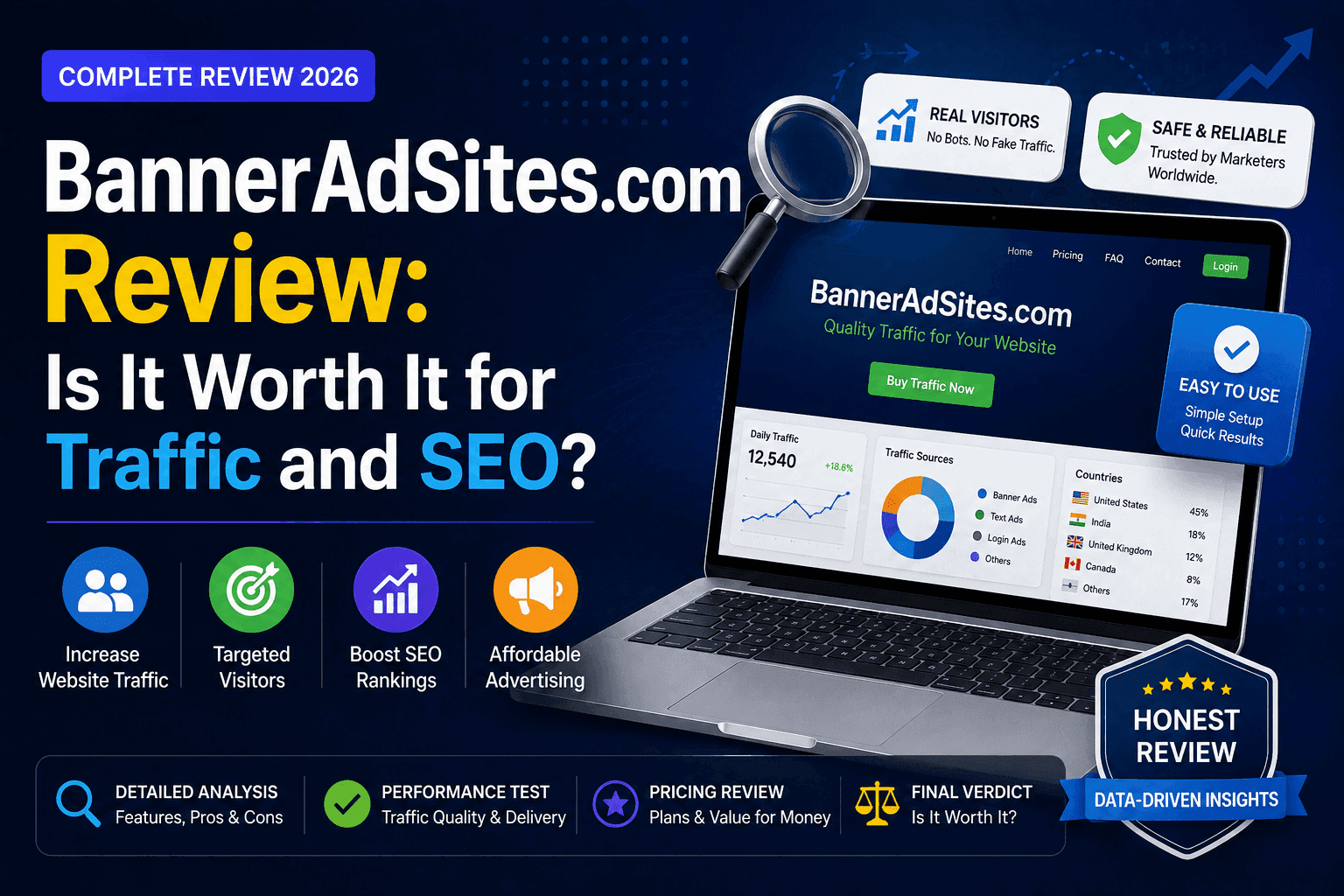
Quick verdict: A one-page broker listing 300+ banner ad placements in a public spreadsheet. Contact runs through Gmail, Telegram and WhatsApp. There is a 7-day refund promise but no company details, no terms and no track record. Treat it as an unverified marketplace, not a vendor.
Score: 4.1 / 10
What Is BannerAdSites.com?
BannerAdSites.com is a listing service for banner advertising. The page headline offers “300+ High Authority Banner Ad Sites” for 2026, and the pitch underneath is short: buy banner ads, get quality traffic, grow faster.
The actual product sits in an embedded Google Sheet. That sheet is described as holding metrics, traffic figures, niche, and pricing for each site on the list. You browse it, pick a placement, then message the seller to book it.
Placement options mentioned on the page include standard banner ads, sitewide banners, and a choice between permanent and monthly terms.
So the business model is straightforward brokerage. The operator does not own the websites in the list. They arrange placements on them and take a margin. That is a normal way to run an ad brokerage. It also means the quality of what you buy depends entirely on the quality of the list, and the list is controlled by the person selling it to you.
BannerAdSites at a Glance
| Detail | What I found |
|---|---|
| Website | banneradsites.com |
| Type | Banner ad placement broker |
| Pages on the site | One |
| Inventory | Public Google Sheet, 300+ listed sites |
| Placement types | Banner, sitewide banner, permanent or monthly |
| Contact | Gmail address, Telegram, WhatsApp |
| Refund policy | 7 days, stated as no questions asked |
| Pricing on site | Only inside the spreadsheet |
| Company name or owner | Not disclosed |
| Terms of service | Not published |
| Privacy policy | Not published |
| Payment page or checkout | None |
| Case studies or testimonials | None |
| Independent reviews found | None |
That table is the review in miniature. The offer is clear. Everything behind the offer is missing.
How Buying Works
The process has no automation in it at all.
- Open the linked Google Sheet and browse the listed sites.
- Pick a placement based on the metrics shown in the sheet.
- Message the seller on Telegram, WhatsApp or email.
- Agree price and duration, then arrange payment off-site.
- Send your banner creative and destination URL.
There is no dashboard, no order form and no checkout. Payment terms are settled in chat, which means no platform sits between you and the seller if something goes wrong.
The stated 7-day refund policy is a genuine positive here, and I want to give it fair credit. It covers placements that were never put live or that have an issue, and the wording is unusually generous. But a refund promise on a page with no company name behind it is only as good as the person honouring it. Pay through a method that gives you a dispute route, and do not send money in a form you cannot claw back.
The Inventory Sheet Is the Whole Product
Everything you are buying is described in one spreadsheet the seller controls and can edit at any time.
The sheet reportedly lists traffic and authority metrics next to each site. Those numbers deserve scepticism, and not because I assume anyone is lying. Seller-supplied metrics are simply unverified by default, and in this market they go stale fast. A site that had real traffic eighteen months ago can be a shell today while the spreadsheet row stays untouched.
Before you buy any placement from a list like this, pull the numbers yourself:
- Check the site’s traffic in your own SEO tool rather than trusting the sheet
- Look at whether its traffic comes from real topic searches or from brand and junk queries
- Open the site and count how many banner slots are already live on it
- Check whether the pages carrying ads are actually indexed
- See whether the site publishes real editorial content or exists purely to host ads
That last one matters more than anything in the sheet. A page stuffed with fifteen rotating banners and no readers will not send you traffic no matter what its authority score says.
One thing the label should tell you. “High authority” is a metrics claim, not a traffic claim and not a relevance claim. Authority scores are third-party inventions that measure links, not audience. A site can score well and have almost nobody reading it.
Does This Help Your SEO?
This is where most buyers get confused, so I want to be blunt about it.
Banner advertising is not a link-building tactic. It is a display advertising tactic. Those are different jobs with different measures of success.
If a banner link is followed and passes ranking credit, you have bought a paid link. Google’s guidance treats links exchanged for money as link spam when they pass credit, and it asks that paid links be marked with rel="sponsored" or rel="nofollow". Banner placements are advertising by definition, so the correct treatment is a qualified link.
Which leaves the honest position:
- A properly marked banner link gives you brand exposure and referral clicks. No ranking credit.
- A followed, unmarked banner link may pass credit, but it is a paid link inside a network of paid links, which is exactly the footprint Google looks for.
Anyone selling banner placements as an SEO ranking method is selling the second option without saying so. Ask directly whether banner links are nofollowed. If the answer is vague, assume the placement is a risk you are absorbing on the seller’s behalf.
We take the same position when evaluating any paid placement for clients, which is why our off-page SEO work separates paid exposure from earned links instead of blending the two in a report.
Will You Actually Get Traffic?
Set SEO aside and judge it as an ad buy, which is what it is.
Display banner click-through rates are famously poor. Across the wider industry, typical rates sit well under a tenth of a percent, and banner blindness has been a documented usability problem since the late 1990s. Readers have been trained for twenty-five years to skip anything that looks like an ad.
So the maths on a placement is unforgiving. If a site genuinely sends 50,000 monthly visits to the page carrying your banner, a normal CTR puts you in the range of a few dozen clicks. Those clicks are cold, untargeted and arriving from someone else’s audience.
That can still be worth paying for. It just has to be priced like what it is.
Before you buy, work out your break-even. Take the placement price, divide it by a realistic click estimate, and compare the result to what the same click costs you on paid search or paid social. If a banner slot works out at several dollars per cold click, it is expensive display, not cheap traffic.
Trust and Transparency
What checks out:
- The site is live, and the inventory sheet opens
- The offer is stated plainly with no fake scarcity or countdown timers
- A refund window is published up front, which many brokers skip
- Three contact channels are given, and the phone number is in a real format
What does not:
- No company name, owner, or registered address anywhere on the page
- Contact runs through a free Gmail account rather than a business domain
- No terms of service and no privacy policy
- No case studies, screenshots, or client results
- No independent reviews, forum threads or buyer feedback found anywhere
- The entire site is one page, with nothing else indexed in Google
The Gmail address deserves a specific note. A business selling hundreds of ad placements and holding a refund obligation should be reachable at its own domain. Using a free consumer email account for a commercial operation is a small thing, but it is the kind of small thing that tends to travel with other small things.
The absence of any independent review is not proof of anything either. It usually just means the operation is new or small. But it does mean you have no external evidence to rely on, and you should size your first order accordingly.
Pricing
No pricing appears on the website. Rates live inside the spreadsheet, and they vary by site and placement type.
Because pricing is per placement and quoted in chat, here is what your first message should nail down:
- The exact page or pages the banner will appear on
- Whether the slot is above or below the fold
- Whether it is exclusive or rotating with other advertisers
- Banner dimensions and file format accepted
- Whether the link will be followed or marked sponsored
- Placement duration, and what “permanent” means in practice
- What proof of placement you will receive
- How the refund is processed and by what method
Get the answers in writing before paying. On a chat-based deal, that conversation is the only contract you will ever have.
Pros and Cons
Pros
- Large inventory in one place, which saves outreach time
- Simple, honest offer with no inflated sales copy
- 7-day refund window is stated clearly and is unusually generous
- Multiple direct contact channels with likely fast replies
- Permanent and monthly options give some flexibility
- Low commitment, so a small test costs little
Cons
- One-page website with no company information at all
- No terms of service or privacy policy
- Contact through a free email account
- All metrics are seller-supplied and unverified
- No case studies, testimonials or independent reviews
- No checkout, so payment happens off-platform with no buyer protection
- Banner links are advertising, so they should not pass ranking credit
- Display CTR is low, making cold traffic expensive per click
- The inventory sheet can be edited after you have seen it
Who Should Use It, and Who Should Skip It
It may suit you if you:
- Want cheap brand exposure and understand it is not an SEO tactic
- Are in crypto, iGaming, finance, or another niche where mainstream ad networks reject you
- Can verify site metrics independently before buying
- Are testing with a small budget you can afford to lose
- Want to save time on manually finding sites that sell banner slots
Skip it if you:
- Are buying it to improve rankings
- Need measurable ROI and proper campaign attribution
- Must justify vendor choices to a client or finance team
- Need a real contract, invoice, and company details
- Have access to Google Ads or Meta, where the same budget buys targeted, trackable clicks
That last point is the one I would press hardest. For most businesses, a few hundred dollars in a properly targeted ad account will beat a few hundred dollars of untargeted banner impressions, and you get real reporting with it.
What to Ask Before You Pay
- Which exact URL will my banner appear on?
- Is the slot exclusive or shared with a rotation?
- Will the link be followed or marked nofollow or sponsored?
- How many other banners already run on that page?
- Can you show live examples of current advertisers on that site?
- What is the real monthly traffic to that specific page, not the domain?
- How long until it goes live, and what proof will I get?
- Does “permanent” mean permanent, or until the site owner changes theme?
- What payment methods do you accept?
- How exactly is a refund processed within the 7-day window?
Keep every reply. A chat log is thin protection, but it is better than nothing.
A Better Use of the Same Budget
If your goal is rankings, banner ads are the wrong tool entirely. Buy relevance instead.
Editorially earned links. Original data, expert commentary and genuinely useful resources attract links nobody can take away or deindex. Slower, and it holds.
Targeted paid traffic. If you want clicks this week, a search or social campaign gives you targeting, tracking and a way to switch off what is not working. A banner on a stranger’s sidebar gives you none of that.
Fixing your own site first. Thin pages, broken internal links and slow load times cost most sites more visibility than any external placement would ever add. Every campaign we run through our link building service starts with that audit, because sending traffic into a leaky site wastes the spend.
Final Verdict
| Category | Score |
|---|---|
| Transparency | 2 / 10 |
| Ease of use | 6 / 10 |
| Inventory size | 7 / 10 |
| Metric reliability | 3 / 10 |
| SEO value | 2 / 10 |
| Traffic value | 4 / 10 |
| Buyer protection | 4 / 10 |
| Overall | 4.1 / 10 |
BannerAdSites.com is a broker with a large list and almost no verifiable identity behind it. The offer is stated honestly, the refund policy is fair on paper, and the inventory could genuinely save you outreach time.
But you are buying unverified placements from an anonymous seller, paying in chat, and receiving links that should not pass ranking credit anyway. That is a lot of unknowns for a tactic with weak upside.
If you want to test it, test small. Buy one placement, verify it went live where promised, track the referral traffic in analytics for thirty days, and let the actual numbers decide the second order. Do not scale on a promise.
Not sure whether a placement or vendor is worth paying for? Get a free SEO audit from RankUp4u, and we will give you a straight answer.
FAQs
Is BannerAdSites.com legit?
The site is live, the inventory sheet opens, and the offer is described plainly. What I could not verify is who runs it. No company name, address, terms, or privacy policy appears anywhere, and no independent buyer reviews exist. Treat it as unproven rather than proven bad.
Will banner ads from this list improve my rankings?
They should not, and if they do, that is a warning sign. Banner placements are advertising, and Google asks that paid links be marked sponsored or nofollow. A followed paid banner link sits inside the pattern Google treats as link spam.
Are the traffic and authority metrics in the sheet accurate?
They are supplied by the seller and unverified. Authority scores measure links, not readers, and traffic figures in broker lists go stale quickly. Check every site in your own tool before buying.
How much does a banner placement cost?
Prices are not shown on the website. They sit inside the linked spreadsheet and vary by site and placement type, so you have to browse the sheet or ask directly.
Is the 7-day refund policy reliable?
The policy is clearly stated and covers placements that never go live or have issues. Whether it is honoured depends entirely on the operator, since no company details or terms back it. Pay through a method that allows a dispute.
Is this better than Google Ads for traffic?
For most businesses, no. Google Ads gives you targeting, conversion tracking, and the ability to pause what fails. A static banner on someone else’s site gives you impressions and hope.
Who is it actually useful for?
Advertisers in niches that mainstream ad networks reject, such as crypto and iGaming, and anyone who wants brand exposure on relevant sites and can verify those sites themselves.

Usama Bin Qasim is an SEO expert and content writer with 6+ years of experience in SEO and digital marketing. He writes practical SEO guides, SaaS and software reviews, tool comparisons, and digital marketing content based on hands-on research and real-world experience.

One Reply on “BannerAdSites.com Review: Is It Worth It for Traffic and SEO?”