
I’ve spent years buying, auditing, and cleaning up backlinks for SaaS companies, and here’s what I’ve learned: the SaaS link building services market is full of noise. You just type the phrase into Google and you’ll mostly find agencies ranking themselves first, on their own blog, in their own listicle.
That gets old fast when you’re the one signing the invoice.
So I did this differently. I looked at what each provider actually does, who they say they work with, how they price their work, and what kind of sites they place links on. No agency here paid me to be included, and no agency here ranked itself.
Below are 11 SaaS link building services worth your time in 2026, sorted roughly from premium and strategic to budget and marketplace-style. I’ve included pricing where it’s public, a comparison table, and a short framework at the end so you can match a provider to your stage and budget instead of just picking whoever’s at the top of the list.
What SaaS Link Building Actually Means
A SaaS link building service helps a software company earn backlinks from other websites. Those links tell Google (and increasingly, AI search tools like ChatGPT and Perplexity) that your product or content is worth trusting and citing.
SaaS link building isn’t quite the same job as link building for a local business or an ecommerce store. A few things make it different:
- The buyer is technical. Links need to come from sites your actual audience reads, like industry blogs, review platforms, and trade publications, not generic “business” blogs.
- Sales cycles are long. A single backlink rarely drives a signup directly. It works by compounding rankings over months, which then feed a funnel that already has to nurture leads for weeks or longer.
- Competitors already rank. Most SaaS categories are crowded. You’re not just building links, you’re closing an authority gap against companies that started earlier.
- AI visibility now matters too. Being cited in AI-generated answers depends on the same signals search engines use: mentions, links, and topical authority from relevant sites.
That’s why a generic guest posting service and a dedicated SaaS link building agency can produce very different results for the same budget.
How I Ranked These Services
I judged every provider on the same five things, because these are the factors that actually predict whether a link building engagement works or wastes your budget.
- SaaS or B2B tech relevance. Does the provider understand software buying cycles, or are they applying the same playbook to every industry?
- Vetting and transparency. Can you see or approve the sites before a link goes live, and does the agency explain why a site qualifies?
- Link quality signals. Real organic traffic, editorial standards, dofollow links, and no private blog networks (PBNs).
- Pricing clarity. Published pricing, tiered packages, or at least a clear process for getting a quote.
- Reporting. Whether you get visibility into what’s live, what’s pending, and what impact it’s having.
None of these providers is the single “best” option for everyone. A Series A startup with a $2,000 monthly budget and an enterprise SaaS company with a dedicated SEO team need very different partners, and I’ve flagged that throughout.
The Best SaaS Link Building Services in 2026
1. uSERP
uSERP runs digital PR campaigns aimed at landing your brand on well-known publications like Forbes, HubSpot, and Business Insider. Instead of guest posts, they focus on editorial mentions and links that come from genuine coverage, not paid placements dressed up as articles.
Their process includes competitor gap analysis, anchor text planning, and toxic link audits, so link building sits inside a broader SEO strategy rather than existing as an isolated task. Published pricing tiers start around $5,500 a month, moving up to roughly $15,000 a month for their top tier.
Best for: Funded, growth-stage SaaS companies that want brand-building media coverage alongside SEO value.
Pros
- Editorial links from sites you could rarely reach through cold outreach alone
- Clear, published pricing tiers instead of a mystery quote
- Strategy work (anchor text, gap analysis) included, not sold separately
Cons
- Out of budget range for early-stage or bootstrapped startups
- Requires an ongoing monthly retainer, not a one-off order
2. Skale
Skale is a London-based agency that works exclusively with SaaS and B2B tech companies, and has since 2019. Link building is one piece of a wider SEO system that also covers content and technical SEO, with campaigns reported against pipeline metrics like signups and demos rather than just rankings.
They’ve built a reputation for connecting off-page work to revenue outcomes, and their published case studies mention SaaS brands like G2 and Maze. Pricing isn’t published, so you’ll need a custom quote.
Best for: SaaS companies that want link building folded into a full SEO program instead of managed as a separate vendor relationship.
Pros
- Deep, SaaS-only specialization with no split focus across industries
- Reporting tied to business metrics, not just link counts
- Adds AI-search and entity optimization work alongside traditional links
Cons
- No public pricing, so budgeting takes an extra step
- Not a fit if you only want standalone links without a broader SEO relationship
3. Siege Media
Siege Media takes a content-first approach. Instead of buying placements, they build linkable assets such as long-form guides, original data studies, and infographics, then use digital PR to get those assets in front of publishers who link to them naturally.
This model produces links that keep compounding for months or years after the content goes live, which is a real advantage over one-off placements. It also means results build up slowly rather than arriving in the first month.
Best for: SaaS companies with the budget and patience to invest in content that earns links over time, rather than paying per placement.
Pros
- Links feel natural because they’re earned, not purchased
- One strong asset can keep generating links long after launch
- U.S.-based team with a strong content production track record
Cons
- Slower to show results than direct outreach or marketplace models
- Cost-per-link is hard to predict since volume depends on content performance
4. Page One Power
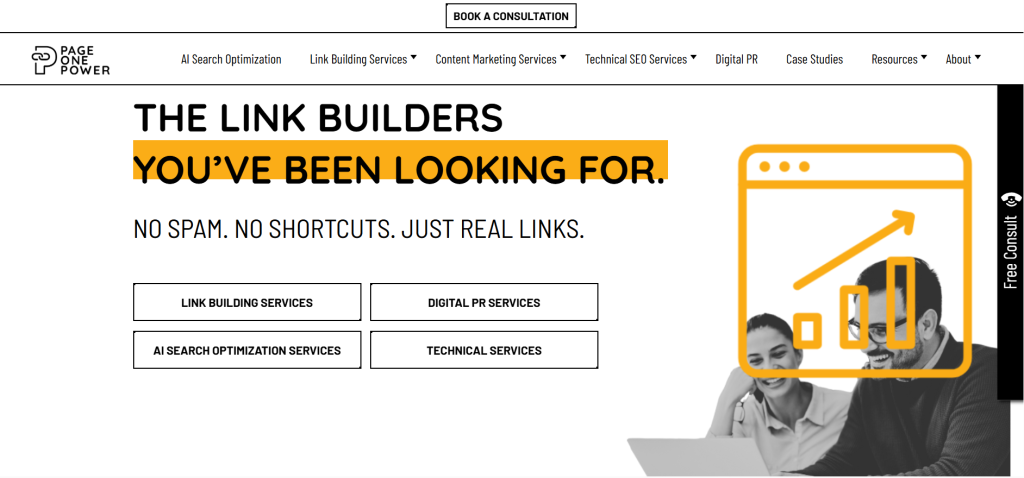
Page One Power builds custom link building programs through manual, one-to-one outreach. They’re known for being transparent about their process, publishing detailed educational content about how link building actually works instead of hiding it behind a sales page.
Every engagement is scoped individually, which makes them flexible for companies ranging from small SaaS startups to large enterprise sites, but it also means there’s no set price list to reference upfront.
Best for: Teams that want a patient, guideline-compliant partner and are willing to go through a custom scoping process.
Pros
- Strong reputation for staying within Google’s guidelines
- Educational, transparent process that explains the “why” behind each link
- Scales from SMB to enterprise scope
Cons
- No published pricing
- Slower pace than marketplace-style providers
5. Editorial.Link
Editorial.Link focuses on one thing: manual outreach for genuinely editorial backlinks. They explicitly avoid private blog networks and other shortcut tactics, and lean heavily on vetting each prospective site for relevance and authority before pitching it.
This is a narrower service than a full SEO agency. If you already have content ready to promote and just need outreach done properly, this kind of specialist can be a good fit.
Best for: SaaS teams that already produce strong content and need dedicated, quality-first outreach to build links to it.
Pros
- Strict no-PBN policy and a clear quality bar
- Narrow focus means less upsell pressure toward unrelated services
- Good option if you have in-house content but no outreach capacity
Cons
- Doesn’t cover content creation, so you need that piece elsewhere
- Manual vetting means slower scaling for large campaigns
6. Loganix
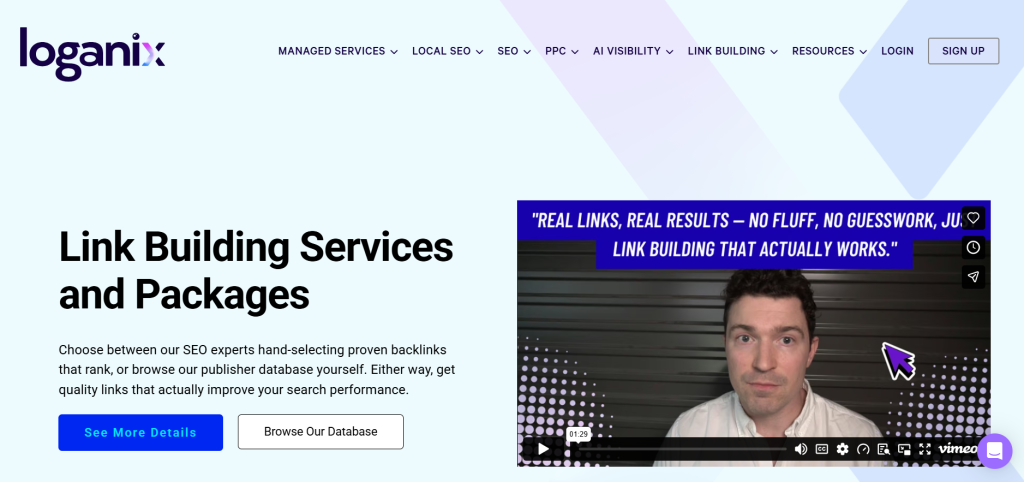
Loganix blends a marketplace with agency-style service. The standout feature is buyer pre-approval: you review and approve every domain before any content gets written or published, which removes a lot of the guesswork you get with blind marketplace orders.
Pricing is organized by verified organic traffic tiers (roughly 1,000, 5,000, and 10,000+ monthly visits) instead of vanity metrics like Domain Authority alone, which is a more honest way to price a link.
Best for: Agencies and in-house teams that want real control over which sites their links come from.
Pros
- Full pre-approval before anything goes live
- Traffic-based pricing tiers are harder to game than DA-based ones
- Works well for white-label and agency reselling
Cons
- Costs more per link than bulk marketplace options
- Manual vetting can slow down larger orders
7. LinkBuilder.io
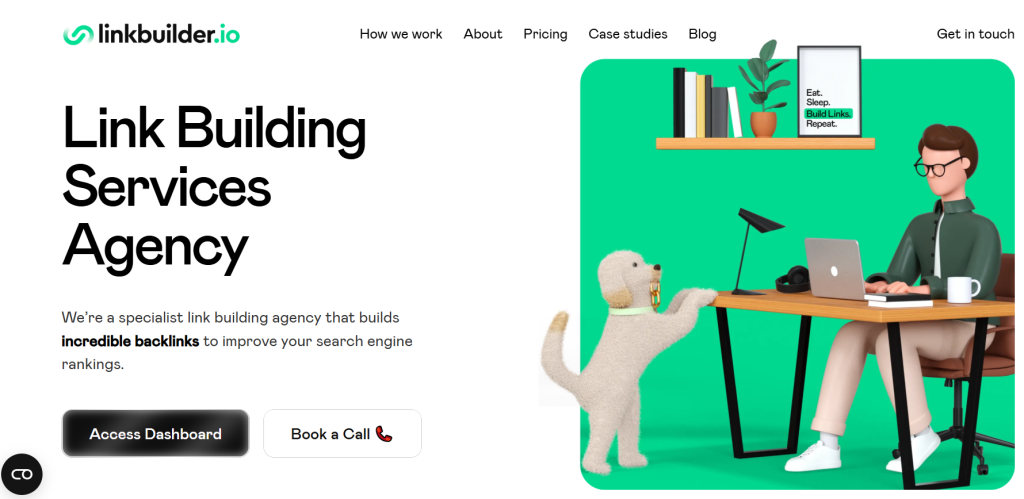
LinkBuilder.io runs managed monthly packages built around DR 50 to 90+ placements, with competitor gap analysis and anchor text planning built into every tier. For clients who qualify, they also offer an invite-only, pay-per-link option for more targeted campaigns.
The tiered structure makes it easier to forecast cost and volume month to month compared to fully custom-quoted agencies.
Best for: Marketing teams that want predictable monthly link volume without negotiating a custom scope every time.
Pros
- Published package tiers make budgeting straightforward
- Strategic work (gap analysis, anchor planning) included in the package
- Transparent reporting dashboard for tracking live links
Cons
- Premium tiers get expensive for smaller SaaS sites
- The pay-per-link option isn’t open to everyone
8. Stellar SEO
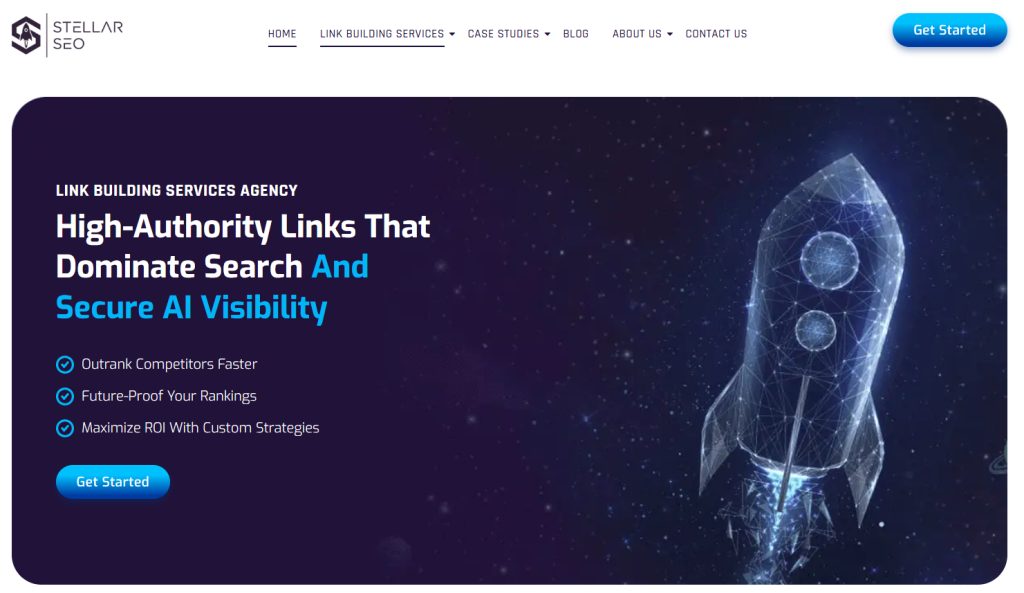
Stellar SEO offers both a la carte guest posts and niche edits at set prices, plus monthly retainers for ongoing campaigns. Every placement goes through a documented 27-point quality check before it’s approved, covering things like real traffic, topical relevance, and editorial standards.
This hybrid model is useful if you want to test the waters with a small order before committing to a bigger monthly program.
Best for: Agencies and SMBs that want transparent per-link pricing with the option to scale into a retainer later.
Pros
- Documented quality checklist applied to every site
- Flexible: start small with a la carte links, scale to a retainer
- White-label reporting available for agencies reselling the service
Cons
- Not the cheapest per-link option on the market
- Placements typically take around 30 days to go live
9. FatJoe
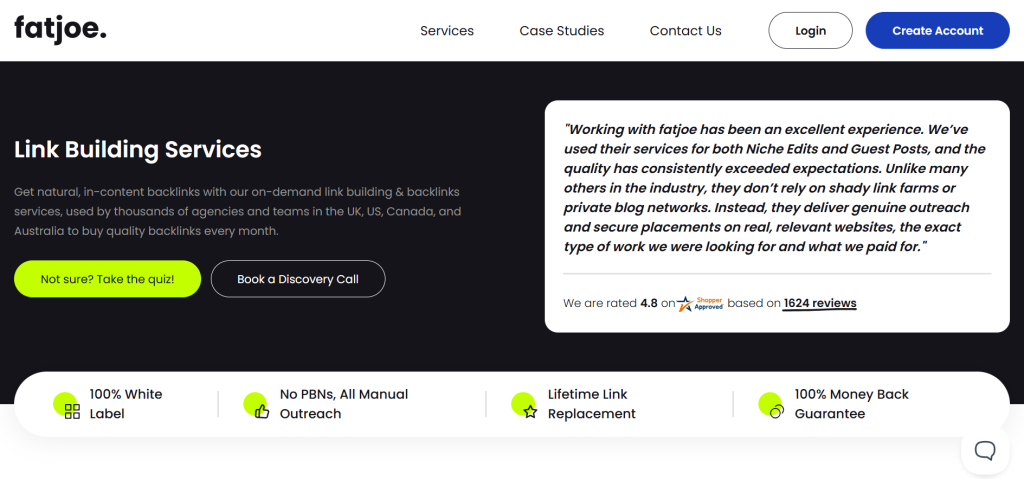
FatJoe is a productized blogger outreach service. You order links through a dashboard, filtered by Domain Authority or traffic tier, and they handle content creation and placement on your behalf. It’s built for speed and volume rather than deep customization.
The tradeoff for that speed is less control. You generally can’t pre-approve the exact domain before your content is published on it, which matters if brand safety is a concern.
Best for: SaaS teams that need a steady, budget-friendly volume of links and don’t need to approve every single domain.
Pros
- Fast turnaround and simple ordering process
- Transparent, tiered pricing by DA or traffic
- Money-back and replacement guarantees on underperforming links
Cons
- No domain pre-approval before content goes live
- Less suited to premium, top-tier editorial placements
10. Authority Builders
Authority Builders runs a self-serve guest post marketplace. You browse a catalog of vetted sites, filter by DA, DR, traffic, and niche, then select exactly which sites you want your content placed on. Their team handles the writing and publishing after you pick.
This puts more strategic control (and responsibility) on you compared to a fully managed agency, so it works best when someone on your team already knows what a good link profile looks like.
Best for: Experienced in-house SEO teams or agencies that want to hand-pick placements instead of trusting an agency’s judgment.
Pros
- Full visibility into the exact sites available before you buy
- Broad inventory spanning many niches and authority levels
- Simple, agency-friendly ordering dashboard
Cons
- Site quality still varies, so you need to vet carefully yourself
- Guest posts only, not a fit for digital PR-style campaigns
11. The HOTH
The HOTH is one of the largest general SEO marketplaces, and link building is just one of many services they sell. Their catalog covers manual outreach, link insertions, press releases, and content syndication, with pricing that scales by Domain Rating tier. Entry-level products like content syndication start around $99, while premium editorial placements at DR 50+ run well past $500 per link.
It’s worth noting this isn’t a SaaS-specific agency. You’re one client among many industries, which means less built-in understanding of software buying cycles compared to a vertical specialist.
Best for: Early-stage or budget-constrained SaaS teams that want a lot of entry points and don’t need vertical specialization yet.
Pros
- Extremely wide range of price points and product types
- Fast, self-service ordering with clear tiered pricing
- Useful for building foundational link volume early on
Cons
- Not SaaS-specialized, so relevance can be hit or miss
- Quality varies significantly across their lower-priced tiers
Quick Comparison Table
| Service | Best For | Pricing Model | SaaS Specialization |
|---|---|---|---|
| uSERP | Funded SaaS wanting media coverage | Tiered retainer (~$5.5K–$15K/mo) | Medium |
| Skale | Full SEO + link building program | Custom quote | High |
| Siege Media | Long-term, content-led link growth | Custom quote | Medium |
| Page One Power | Guideline-safe custom programs | Custom quote | Medium |
| Editorial.Link | Outreach only, existing content | Custom quote | Medium |
| Loganix | Full domain pre-approval | Traffic-tiered | Medium |
| LinkBuilder.io | Predictable monthly volume | Published tiers | Medium |
| Stellar SEO | Flexible per-link or retainer | Per-link + retainer | Medium |
| FatJoe | Fast, budget-friendly volume | Published, DA-tiered | Low-Medium |
| Authority Builders | Hands-on, self-serve control | Marketplace, varies | Low-Medium |
| The HOTH | Wide range of entry-level links | Published, DR-tiered | Low |
How Much Do SaaS Link Building Services Cost?
Pricing in this space falls into three rough bands. Knowing which one you’re shopping in saves a lot of back-and-forth with sales calls.
- Marketplace and budget tier: Roughly $60 to $500 per individual link, depending on the site’s authority and traffic. Good for building foundational volume, less useful for premium brand-building placements.
- Mid-market managed programs: Typically $1,500 to $6,000 a month for an ongoing campaign with strategy, vetting, and reporting included.
- Premium digital PR and enterprise SEO: Often $5,000 to $15,000+ a month, aimed at companies chasing top-tier editorial coverage and willing to treat link building as a brand investment, not just an SEO line item.
A practical example: a bootstrapped SaaS tool with a $1,500 monthly SEO budget will get more usable volume from a marketplace like FatJoe or The HOTH than from a $10,000-a-month digital PR retainer. A funded, Series B company chasing category authority against entrenched competitors is usually better served going the other way, even at a higher monthly cost.
How to Choose the Right SaaS Link Building Partner
Work through these questions before you sign anything:
- Can they show you real examples of SaaS links they’ve built? Not just DA scores, actual live links on sites your buyers would recognize.
- Do they explain their vetting process? If the answer is vague, that’s a signal they’re reselling marketplace inventory without checking it.
- What’s their link replacement policy? Links get taken down over time. A provider with no replacement guarantee is putting all the risk on you.
- Do they understand your buying cycle? A generic outreach agency and a SaaS-focused one will pitch very different sites for the same target page.
- Is pricing tied to real traffic, or just Domain Authority? DA and DR are easy to inflate. Organic traffic is harder to fake.
Watch for these red flags too:
- Guaranteed rankings or guaranteed “page one” promises
- Pressure to sign a 12-month contract before you’ve seen a single sample link
- No willingness to name even one example client or live placement
- Pricing based only on DA/DR with no mention of traffic or relevance
Quick Summary
If you want the short version: uSERP and Skale suit funded SaaS companies chasing brand authority and pipeline, Siege Media fits teams investing in long-term content-led growth, Page One Power and Editorial.Link work well for guideline-safe manual outreach, Loganix, LinkBuilder.io, and Stellar SEO sit in the mid-market with more transparency and control, and FatJoe, Authority Builders, and The HOTH are the practical picks for early-stage or budget-conscious teams that need volume now.
FAQs
What is SaaS link building?
SaaS link building is the process of earning backlinks from other websites specifically for software companies. It focuses on getting links from sites relevant to your industry, like tech blogs, review platforms, and trade publications, since those carry more weight for SaaS SEO than generic links.
How much do SaaS link building services cost?
Costs range from around $60 to $500 per link on marketplace platforms, up to $1,500 to $6,000 a month for managed mid-market programs, and $5,000 to $15,000+ a month for premium digital PR agencies.
How long does it take to see results from SaaS link building?
Most SaaS companies start seeing measurable ranking movement in 3 to 6 months. Digital PR and content-led approaches often take longer to build momentum but tend to compound better over the following year.
Are guest posts still effective for SaaS SEO in 2026?
Yes, when they come from real, relevant sites with actual traffic. Guest posts on low-quality or irrelevant sites add little value and can even hurt your backlink profile if they look manipulative. We ran into exactly this problem evaluating a widely-pitched site — see our Voozon review for a real example.
What’s the difference between link building and digital PR?
Link building typically means outreach for guest posts and niche edits. Digital PR means pitching stories and data to journalists and publications, which results in editorial mentions and links as a byproduct of genuine coverage.
Can I do SaaS link building myself instead of hiring a service?
Yes, tools like BuzzStream and Respona let in-house teams manage prospecting and outreach directly. This takes more time and expertise than hiring a specialist, but it gives you full control over which sites you approach.
How many backlinks does a SaaS website need to rank well?
There’s no fixed number. What matters more is the relevance and authority of each link relative to your competitors’ backlink profiles. A competitor gap analysis is a better starting point than chasing a link count.
Can bad link building get my SaaS site penalized?
Yes. Paid links that aren’t disclosed, PBNs, and low-quality bulk guest posts can trigger a Google penalty or a manual action. That’s why vetting and transparency matter more than raw link volume.
Final Thoughts
Choosing from the best SaaS link building services in 2026 comes down to matching a provider to your stage, not chasing whichever agency ranks itself first. A bootstrapped startup and a Series C company aren’t shopping for the same thing, even if they’re both typing the same search term into Google.
Start with two or three providers that fit your budget from the list above, ask for real examples of links they’ve built for SaaS clients, and run a small pilot before committing to a long retainer. That single step saves more money than any amount of comparison shopping.

Usama Bin Qasim is an SEO expert and content writer with 6+ years of experience in SEO and digital marketing. He writes practical SEO guides, SaaS and software reviews, tool comparisons, and digital marketing content based on hands-on research and real-world experience.

One Reply on “Best SaaS Link Building Services in 2026 (Ranked & Compared)”