
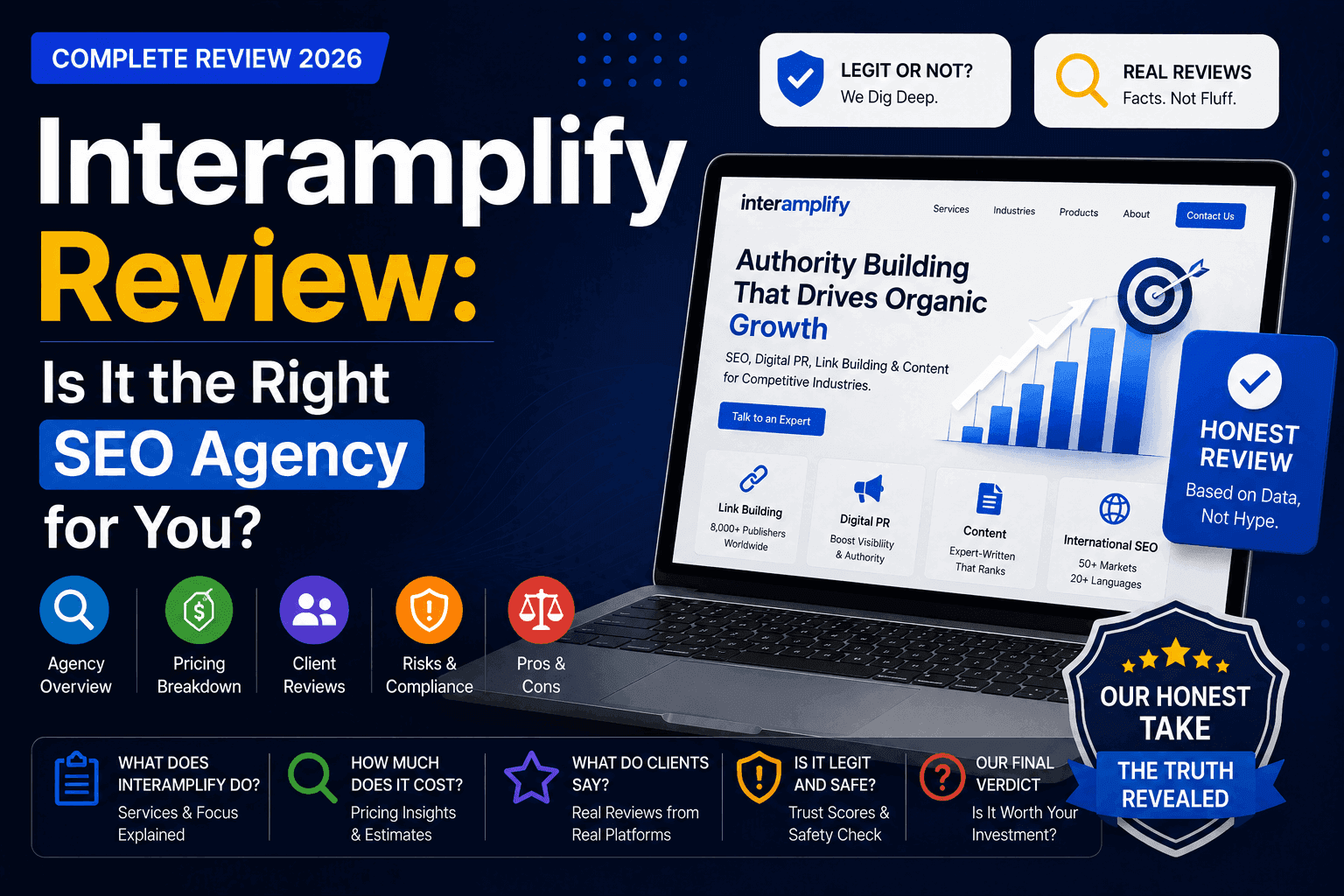
About Me and How I Reviewed This Agency
I’m part of the content and SEO strategy team at RankUp4u. Reviewing other agencies and SEO tools is part of my regular work. I know what to look for, and where agencies tend to hide the weak spots.
For this review, I didn’t just read Interamplify’s homepage and repeat its claims. I worked through the site page by page: services, products, and the about page. Then I checked the domain against two outside safety scanners. I read its Trustpilot and Glassdoor listings too. On top of that, I read seven other published reviews of Interamplify. I wanted to see what they found, what they missed, and where their numbers didn’t match up.
This review is scored across five metrics:
- Services and positioning – how clear and specific the offer is
- Pricing transparency – how easy it is to know what you’d actually pay
- Trust and safety signals – what independent scanners and WHOIS data show
- Client and team reputation – what real reviews from clients and employees say
- Compliance risk – whether any tactics could put a client’s site at risk with Google
I have no business relationship with Interamplify. Nobody there paid for or reviewed this article. Everything below is based on what I found in August 2026, and it’s worth remembering that pricing, reviews, and trust scores can shift over time.
Introduction
Interamplify markets itself as a global authority-building agency. It targets brands in tough, regulated markets like iGaming, crypto, and finance. The pitch sounds strong: over 100 in-house specialists, 8,000+ publishers, and proprietary tools with big claimed results.
But a pitch is not proof. I wanted to know what actually backs these claims up. So I read the agency’s own pages closely. I checked outside safety scanners. I looked at real reviews from clients and employees too. This article walks through everything I found, section by section. By the end, you can decide for yourself if SEO agency Interamplify is worth a conversation.
Quick Verdict
Here’s the short version, if you’re short on time.
| Metric | My Score (out of 5) | Why |
| Services and positioning | 4 | Clear service lines and named products, backed by first-party detail |
| Pricing transparency | 1.5 | No published pricing anywhere; figures only come from third-party estimates |
| Trust and safety signals | 2.5 | One scanner says safe, another flags medium risk and GDPR-masked ownership |
| Client and team reputation | 2 | Very few reviews on Trustpilot and Glassdoor, and the ones that exist are mixed |
| Compliance risk | 2.5 | One flagship product uses tactics that carry real risk under Google’s guidelines |
| Overall | 2.5 / 5 | A real, established agency with genuine capability, but thin public accountability |
Interamplify is not a scam. It has a real team, real named leadership, and real service infrastructure. But the lack of published pricing, the very small review base, and one aggressive ranking tactic mean you should go in with your eyes open.
What Is Interamplify?
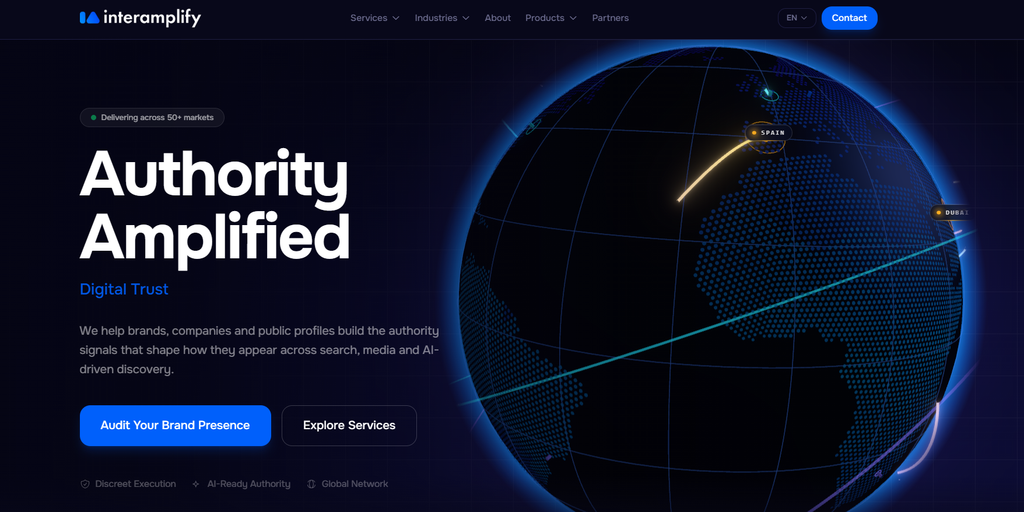
Interamplify calls itself an international team. Its stated goal is to help brands “strengthen their reputation, presence, and trust.” It says it has more than 100 in-house specialists. They work across 50-plus markets, with 10-plus years of international operations.
The leadership team is named on the site:
- Javier Gázquez, CEO and Founder
- Miguel Ángel Almela, CMO and Partner
- Nelly Garkova, Deputy CEO
- Manuel Ayllón, COO
- Santos Belchi, CFO
- Kun Álvarez, CIO
- Jesús Ruiz, CTO
That level of named leadership is a good sign. Plenty of the sites I’ve reviewed hide behind anonymous bylines. Interamplify doesn’t do that.
The agency describes itself as “confidential by default,” with “no public client references.” That’s a deliberate choice. It’s common in industries like gambling and finance, where clients don’t want their vendors named publicly. It does mean you can’t easily verify past work through public case studies.
Services and Products Breakdown
Interamplify organizes its work into four service lines:
| Service Line | What It Covers |
| Link Building and Digital PR | Editorial placements through a claimed network of 8,000+ publishers across 50+ countries |
| Managed Organic Growth | Full SEO operations, including technical health, content, and authority building |
| News, Discover and AI Visibility | Google News and Top Stories optimization, plus AI answer monitoring |
| Content and Internationalization | Native multilingual content built by subject-matter experts |
On top of those, the site lists eight named products. I’m including the exact claims from the site itself. Some outside reviews used different product names, ones I couldn’t match to what’s live on the site today:
- ORS (Organic Ranking Signals): claims ranking boosts in “hours, not weeks,” using .edu, .gov, and top-tier social sources
- Predictive Boost: aims for “#1 autocomplete position” in Google Suggest
- RadarAI: monitors brand sentiment across ChatGPT, Claude, and Gemini
- GTS (Google Top Stories Boost): claims a “99% placement success rate”
- Brand Protection: 24/7 monitoring to push down negative search results
- Organic Growth: claims a “+790% organic traffic increase” through technical and content work
- Link Building: the 8K+ publisher network described above
- Internationalization: claims to take a brand “from invisible to Top 5 in 6 months” when expanding from Asia into Western markets
These are specific, checkable claims, which I’ll give credit for. Vague marketing copy is much harder to evaluate than named percentages and named tools.
Who Interamplify Actually Serves
The agency lists six target industries: iGaming, crypto, finance, pharma and health, legal services, and public figures or VIPs. These are all sectors where standard marketing channels, like paid social ads, are restricted or banned outright. That’s likely why SEO and digital PR matter so much to Interamplify’s pitch.
If your business sits in one of these regulated categories, Interamplify’s positioning starts to make more sense. Do you run a small local business or an early-stage startup? Then this agency’s whole model probably isn’t built with you in mind, from its named industries down to its budget range.
Pricing: What It Actually Costs
Interamplify does not publish pricing on its own site. I looked through every page I could find, and the only options offered are “Request Authority Audit” or “Talk to a Strategist.”
Since the agency itself stays quiet on cost, I pulled numbers from other sources that have covered it:
| Source | Reported Figure |
| Client-reported (via a competing review site) | Over $5,000/month for multilingual SEO |
| Independent review site | Project budgets starting around $2,500 |
| Semrush agency listings (general range, not Interamplify-specific) | $1,000+ to $25,000+ |
None of these numbers come directly from Interamplify, so treat them as estimates, not quotes. What they do suggest is a mid-market to enterprise price range. This isn’t a fit for a shoestring budget. Some agencies show pricing up front, before you ever talk to a sales rep.
Trust and Safety: Two Scanners, Two Different Scores
This is where things get confusing. I ran interamplify.com through two separate, independent safety scanners, and they didn’t agree.
| Scanner | Score | Classification | Key Notes |
| ScamAdviser | 0 (stale, unscanned for 30+ days) | “Very Likely Safe” | Valid SSL, domain registered since 2017, owner identity hidden on WHOIS |
| Scam-Detector | 58.2 / 100 | “Active. Medium-Risk.” | GDPR-masked ownership, algorithm flagged activity linked to phishing/spamming patterns, called it “problematic” |
Both scanners agree on one thing: the site’s ownership details are masked, whether through WHOIS privacy or GDPR protections. That’s common practice, and not automatically a red flag. But it does mean you can’t independently confirm who legally owns the business behind the marketing copy.
The domain itself has been registered since February 2017, which lines up reasonably well with the agency’s own claim of 10-plus years in operation. Domain age alone is a weak trust signal. Still, a nearly decade-old domain with a valid SSL certificate is more reassuring than a brand-new one.
Client Reviews: What Trustpilot Says
Interamplify’s Trustpilot page shows an average of 3.5 out of 5 stars, based on just two reviews. That’s a very small sample to draw conclusions from, but it’s still worth reading.
One reviewer left a one-star complaint, dated October 2025:
“Everything goes smoothly until they receive the payment, but once the money is in, their attitude changes.”
The same reviewer reported that 15 days after payment, work still hadn’t started. I want to be fair here. One review is not a pattern, and I couldn’t independently verify the circumstances. But it’s the kind of specific, dated complaint that’s worth asking Interamplify about directly if you’re considering hiring them. Ask for a written timeline of deliverables before you pay anything.
Inside the Company: What Glassdoor Says
Glassdoor shows a 5.0 out of 5.0 employee rating, based on a single review from a web developer. Every category, from culture to compensation to work-life balance, is rated at the maximum score.
Oddly, the review itself is inconsistent. It’s titled “Excellent company.” Yet the pros section states “This company doesn’t have pros.” The cons section, meanwhile, lists strong points like professional growth and work-life balance. That’s a contradiction. Combined with there being only one review on file, this rating tells us almost nothing reliable about what it’s like to work there.
I’m including this anyway, because a healthy internal culture is part of long-term service quality. An agency that treats its own team well is usually more likely to keep clients’ work staffed consistently. Right now, there just isn’t enough public data to judge that either way.
The Compliance Question: Is ORS Risky?
This is the part of the review I’d flag most for anyone evaluating Interamplify from an SEO practitioner’s chair, not just a buyer’s chair.
Interamplify’s ORS product claims to deliver ranking boosts in “hours, not weeks” by routing traffic through .edu networks, .gov references, and top-tier social platforms. One independent reviewer described this plainly: “Any technique that artificially simulates user engagement to influence rankings carries a compliance risk.”
Google’s own rules are clear on this point. You should earn ranking signals through real relevance and quality. Faking or forcing them instead can lead to a manual penalty. A tool built to force traffic signals fast sits in a gray area at best. If you go this route, ask Interamplify directly how ORS works. Then weigh that answer against your own risk tolerance. A short-term ranking boost isn’t worth much if it puts your whole site at risk later.
How Other Reviews Compare
I read seven other published reviews of Interamplify while researching this one. A few things stood out:
- Two reviews from the same publisher (YonoPress) gave different scores. One called it “legitimate, but not without meaningful concerns,” with a 6.4 out of 10 score.
- One review, published by a competing SEO agency, compared Interamplify against its own services. That’s not automatically dishonest, but it’s a real bias worth knowing about before you weigh that comparison too heavily.
- One review’s headline promised ranking results “across 36 languages,” but that exact figure never actually appeared anywhere in the article’s body text. That’s a sign the headline was written for clicks rather than accuracy.
- Product names varied between reviews. Some called Interamplify’s tools “SERPTopia” and “ORSTraffic,” names that don’t match what’s currently live on Interamplify’s own site (ORS and GTS). This suggests either the products were renamed at some point, or some reviews weren’t checked against the live site.
None of this means those reviews are worthless. It just means cross-checking multiple sources, the way I did here, matters more than trusting any single review at face value, including this one.
Pros and Cons
Pros:
- Named leadership team with real titles, not anonymous bylines
- Specific, checkable product claims rather than vague marketing language
- Nearly a decade of domain history and consistent SSL security
- Clear industry focus (iGaming, crypto, finance, and similar regulated sectors)
- Direct access to senior leadership promised from the first conversation
Cons:
- No published pricing anywhere on the site
- Very small review base on both Trustpilot and Glassdoor
- One unresolved, specific client complaint about post-payment service changes
- Mixed signals from independent trust scanners, including a “medium-risk” flag from one of them
- The ORS product’s traffic-engineering approach carries real compliance risk under Google’s guidelines
- Ownership details are masked, limiting independent verification of who runs the company
Who Should Hire Interamplify
Interamplify is probably worth a conversation if:
- Your business operates in iGaming, crypto, finance, pharma, legal, or another regulated space with limited ad options
- You’re expanding internationally and need native-language content and outreach at scale
- You have a marketing budget that comfortably supports a mid-market to enterprise-level monthly spend
- You’re comfortable with confidential, non-public case studies rather than named client references
You should look elsewhere, or at least dig deeper first, if:
- You run a small business or local operation with a limited monthly budget
- Published, upfront pricing matters to you before the first sales call
- You want a large, verifiable base of independent client reviews before signing
- You’re not willing to accept any ranking approach that pushes close to Google’s guideline limits
A Due Diligence Checklist
If you’re still considering Interamplify, or any agency like it, here’s what I’d personally check before signing anything:
- Ask for three recent client references you can contact directly, even if they’re kept off the public site
- Get a written scope of work and delivery timeline before any payment goes out
- Ask specifically how ORS and any traffic-engineering products work, and whether they’ve ever triggered a Google manual action for a client
- Compare the quoted price against the general market range for the services you actually need
- Request sample backlink placements from past campaigns so you can judge link quality yourself, rather than relying on the publisher-count claim alone
This same checklist applies well beyond Interamplify. Want a reference point for comparison? Our technical SEO and off-page SEO pages walk through what a thorough audit should actually include.
FAQs
Is Interamplify legit?
It appears to be a real, established company with named leadership and a decade of domain history. It’s not a confirmed scam. But the masked ownership details, thin review base, and mixed trust-scanner results mean “legit” doesn’t automatically mean “risk-free.”
How much does Interamplify cost?
Interamplify doesn’t publish pricing. Third-party sources report figures ranging from roughly $2,500 for smaller projects up to $5,000 or more per month for larger multilingual SEO programs. None of these numbers are confirmed directly by the agency, though.
Does Interamplify have good reviews?
Its Trustpilot rating sits at 3.5 out of 5, based on just two reviews, one of which is a detailed one-star complaint. Its Glassdoor rating is a perfect 5.0, but from a single, internally inconsistent review. Neither sample is large enough to be conclusive.
Is Interamplify’s ORS tool safe to use?
It’s a legitimate concern worth raising directly with the agency. ORS is designed to accelerate ranking signals quickly, and tactics like this can carry compliance risk under Google’s search guidelines. Ask for full technical detail before agreeing to use it.
What industries does Interamplify specialize in?
Its site lists six main focus areas: iGaming, crypto, finance, pharma and health, legal services, and public figures or VIPs. Traditional advertising is often restricted in every one of these sectors.
Who owns Interamplify?
Javier Gázquez is listed as CEO and Founder, alongside a named executive team. However, the domain’s WHOIS and registration details are privacy-protected, so full corporate ownership can’t be independently confirmed through public records.
Final Thoughts
Interamplify isn’t a fly-by-night operation. It has real infrastructure, named leadership, and specific product claims that go further than most agencies’ marketing pages. That puts it ahead of a lot of what I’ve reviewed.
At the same time, a few things stand out: no published pricing, a very small public review base, and one aggressive ranking tactic. Together, that means this isn’t a hire-on-faith situation. Treat the sales conversation as the start of your research, not the end of it. Ask direct questions, get everything in writing, and verify claims independently wherever you can, the same way I tried to here.

Usama Bin Qasim is an SEO expert and content writer with 6+ years of experience in SEO and digital marketing. He writes practical SEO guides, SaaS and software reviews, tool comparisons, and digital marketing content based on hands-on research and real-world experience.

One Reply on “Interamplify Review 2026: Is This SEO Agency Worth It?”